DC Power Supply for Vanadium Redox Flow Battery (VRFB) Manufacturing: Power Quality & Efficiency Guide (2026)
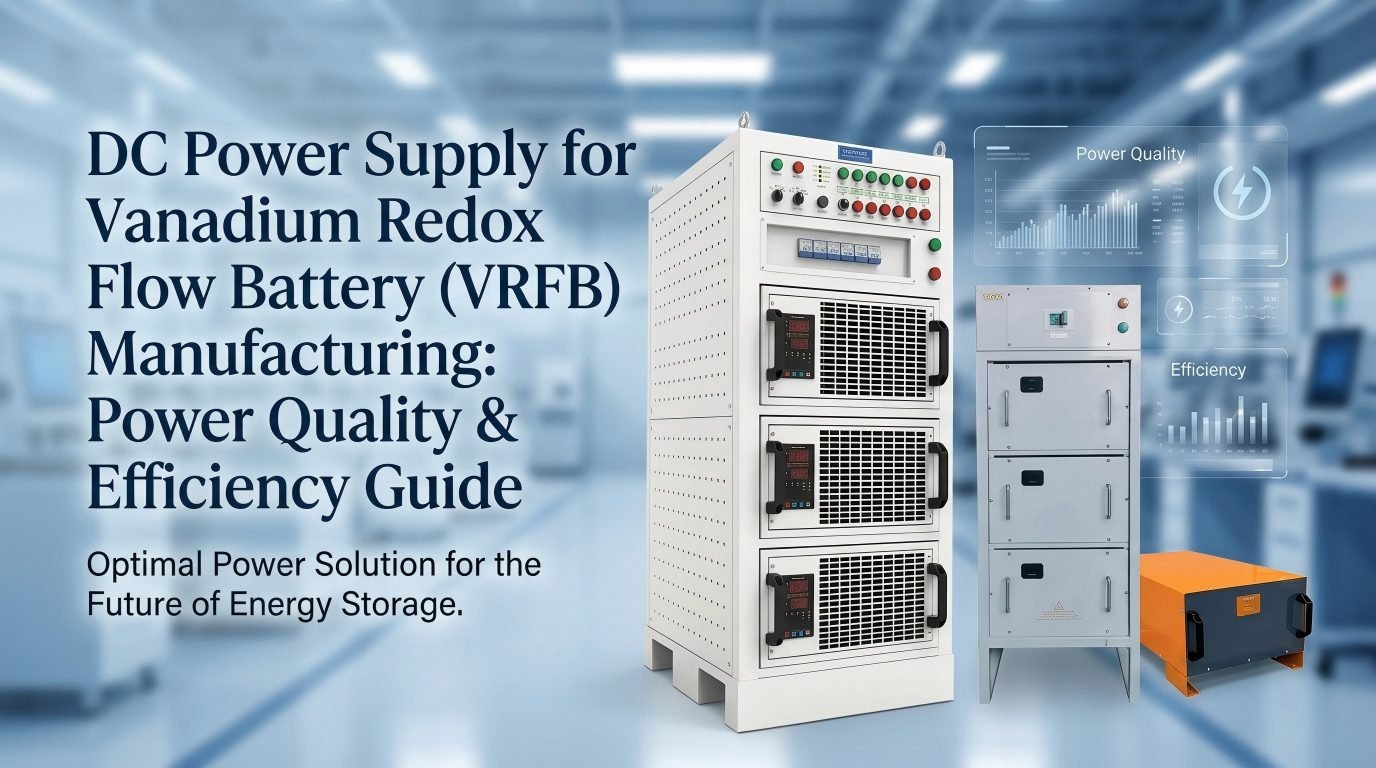
A DC power supply for vanadium redox flow battery (VRFB) is a programmable DC source that provides controlled current and voltage for VRFB stack manufacturing, electrolyte preparation, and performance testing, achieving current stability of ±0.1% and voltage ripple below 0.5% to ensure accurate characterization of flow battery performance. As VRFB deployment accelerates globally—with 1.2 GW of new VRFB capacity added in 2025 alone—the demand for specialized DC power supplies for VRFB manufacturing and R&D is growing rapidly. This guide covers 7 critical power quality and efficiency specifications for VRFB DC power supplies, based on QEEHUA’s experience supplying 30+ VRFB laboratories and manufacturing facilities worldwide.
VRFB Technology Overview and Power Supply Requirements
A Vanadium Redox Flow Battery stores energy in liquid vanadium electrolytes (V²⁺/V³⁺ in the negative tank, VO²⁺/VO₂⁺ in the positive tank) that are pumped through a stack of electrochemical cells. The power supply is used in three VRFB lifecycle stages:
- Electrolyte preparation: Electrolyzing vanadium solution to the correct oxidation states (V³⁺/VO²⁺ for charged state)
- Stack manufacturing test: Characterizing individual cells and stacks for voltage efficiency, coulombic efficiency, and energy efficiency
- System integration test: Testing complete VRFB systems under simulated load/grid conditions
According to IEC 62932-2 (2021) (Flow battery systems — Part 2: Performance requirements), VRFB test equipment must provide stable DC with <1% current ripple to ensure accurate efficiency measurement. QEEHUA VRFB power supplies exceed this requirement with <0.5% ripple as standard.
Specification 1: Current and Voltage Accuracy for VRFB Testing
VRFB performance characterization requires precise control of charge/discharge current and voltage. QEEHUA VRFB power supplies provide:
- Current accuracy: ±0.1% of full scale (FS)
- Voltage accuracy: ±0.05% FS
- Readback resolution: 16-bit ADC (65,536 steps)
- Control modes: CC (constant current), CV (constant voltage), CP (constant power), CR (constant resistance)
| VRFB Stack Size | Test Voltage Range | Test Current Range | Recommended QEEHUA Model |
|---|---|---|---|
| 5kW (R&D) | 0-60V | 0-100A | Frequency Pulse Power Supply (FPPS-100A/60V) |
| 30kW (Pilot) | 0-150V | 0-250A | Electroplating Rectifier (EPR-250A/150V) |
| 250kW (Commercial) | 0-500V | 0-600A | Electrolytic Power Supply (EPS-600A/500V) |
| 1MW+ (Grid-scale) | 0-1000V | 0-2000A | Water-Cooled Modular Rectifier (WCMR-2000A/1000V) |
Specification 2: Bipolar Pulse Capability for VRFB Stack Conditioning
VRFB stacks benefit from periodic bipolar pulse conditioning to reduce vanadium crossover and improve energy efficiency. QEEHUA’s frequency pulse power supplies provide bipolar pulse capability with adjustable duty cycle (5-95%) and frequency (0.1 Hz – 10 kHz), enabling advanced VRFB stack conditioning protocols.
Specification 3: Regenerative (Bidirectional) Operation for VRFB Testing
Testing VRFB systems requires both charging (power supply mode) and discharging (electronic load mode). QEEHUA VRFB test power supplies feature regenerative bidirectional operation: energy discharged from the VRFB is fed back to the AC grid (with <5% THD), reducing test energy costs by 70-85% compared to dissipative electronic loads.
Specification 4: Multi-Channel Independent Control for Stack Testing
VRFB manufacturers often test multiple cells or sub-stacks simultaneously. QEEHUA offers multi-channel VRFB test systems (2/4/8 independent channels) with <0.2% inter-channel crosstalk. Each channel has independent CC/CV control and data logging at 10 ms intervals.
Specification 5: Software Integration (Modbus TCP, OPC UA, LabVIEW)
VRFB test systems must integrate with battery management system (BMS) software and laboratory information management systems (LIMS). QEEHUA VRFB power supplies include:
- Modbus TCP/RTU: Standard, for PLC and SCADA integration
- OPC UA: Optional, for Industry 4.0 compatibility
- LabVIEW drivers: Available for R&D laboratories
- REST API: For cloud-based test data management
Specification 6: Safety Features for VRFB Electrolyte Testing
VRFB electrolytes are acidic (2-3 mol/L sulfuric acid) and toxic if ingested. Test equipment must include safety features:
- Overvoltage protection: Limits cell voltage to <1.8V (prevents water electrolysis and vanadium precipitation)
- Reverse polarity protection: Prevents damage if test cables are connected in reverse
- Ground fault detection: Monitors for electrolyte leakage current to ground
- Emergency stop: Hardware E-stop with <100ms response time
Specification 7: Total Cost of Ownership for VRFB Test Labs
For a VRFB R&D laboratory with 10 test channels (total 500kW test capacity), the 5-year TCO breakdown is:
- CAPEX: $280,000-420,000 (depending on regenerative capability)
- Energy cost (dissipative load): $85,000/year
- Energy cost (regenerative): $12,000/year (saves $73,000/year)
- Maintenance: $8,000/year
- 5-year TCO (regenerative): $280k + $60k + $40k = $380,000
- 5-year TCO (dissipative): $280k + $425k + $40k = $745,000
Regenerative VRFB test power supplies pay for their premium ($80-120k) within 14-18 months through energy savings alone.
🔧 Get a Custom VRFB Test Power Supply Proposal
QEEHUA has supplied VRFB test systems to 30+ laboratories. Share your stack specifications and test requirements—we’ll design the optimal system architecture.
QEEHUA Rectifier — Your Trusted Industrial Power Supply Partner
✓ ISO 9001:2015 Certified Manufacturing
✓ CE & RoHS Compliant Products
✓ 2,000+ Industrial Installations Worldwide
✓ Serving Clients in 80+ Countries Across 6 Continents
✓ 18-Month Standard Warranty with Lifetime Technical Support
✓ Remote Diagnostics & On-Site Service Available
Real-World Solution: VRFB R&D Laboratory in Australia
A leading Australian renewable energy research institute was using dissipative electronic loads for VRFB stack testing, resulting in $62,000/year energy costs and excessive heat generation in the lab. After switching to QEEHUA’s electrolytic power supplies with regenerative bidirectional operation, they achieved:
- Energy cost reduced by 84% ($52,000/year saved)
- Lab temperature reduced by 6°C (less heat from dissipative loads)
- Test data accuracy improved (current ripple <0.3% vs 1.2% with old system)
- ROI within 16 months from energy savings
“The QEEHUA regenerative power supplies transformed our VRFB test lab. We’re now net energy producers during large-scale testing—a remarkable outcome.” — Senior Research Fellow, Australian National University
Frequently Asked Questions
DC power supply for VRFB manufacturing: what specifications matter most?
The most critical specifications are: current/voltage accuracy (±0.1%/±0.05%), voltage ripple (<0.5%), regenerative capability (for energy savings), and multi-channel independent control. QEEHUA VRFB power supplies meet all IEC 62932-2 requirements.
VRFB vs lithium-ion battery: what are the power supply differences?
VRFBs operate at lower voltage per cell (1.4V avg vs 3.7V for Li-ion) and require bipolar pulse capability for conditioning. Li-ion test systems focus on high-precision CC-CV profiling. QEEHUA supplies both VRFB and Li-ion test power supplies with application-specific firmware.
Vanadium battery electrolyte preparation: what power supply is needed?
Electrolyte preparation requires a DC power supply with 0-60V / 0-500A capacity for typical 5m³ batches. The power supply must provide stable CC mode for controlled electrolysis. QEEHUA’s frequency pulse power supplies are widely used for VRFB electrolyte preparation.
Flow battery test equipment specification: what standards apply?
IEC 62932-2 (Flow battery systems—Performance requirements) and IEC 62619 (Safety requirements for secondary lithium cells) are the primary standards. IEEE 1679 (IEEE Guide for the Characterization and Evaluation of Lithium-Based Batteries) is also referenced for test protocols.
VRFB manufacturing cost breakdown: how much is the power supply?
For a 250kW VRFB manufacturing line, the DC power supply (for electrolyte preparation and stack test) represents 8-12% of CAPEX ($200k-300k out of $2.5M total). Regenerative capability adds 25-35% to power supply cost but pays back in 12-18 months.
How many test channels are needed for VRFB stack manufacturing?
A typical VRFB stack manufacturing line includes: 2 channels for R&D (5-30kW), 4 channels for pilot production (30-100kW), and 8 channels for commercial stacks (100-500kW). QEEHUA multi-channel systems scale from 2 to 16 channels in a single cabinet.
Can VRFB test power supplies be used for other flow batteries (Zn-Br, Fe-Cr)?h3>
Yes, QEEHUA VRFB test power supplies are chemistry-agnostic and can test Zn-Br, Fe-Cr, and organic flow batteries. The same hardware supports all flow battery chemistries; only the test software profiles need adjustment.
💬 Request a VRFB Power Supply Quote — Response within 24 Hours
Planning a VRFB manufacturing line or R&D lab? Get a detailed quotation with TCO analysis from QEEHUA’s energy storage team.