Introduction: Choosing the Right Cooling Technology
For electroplating facilities across Guangdong, Fujian, and Zhejiang provinces, selecting between water-cooled and air-cooled rectifier systems represents a critical engineering decision that impacts both operational costs and production quality. This comprehensive guide examines the technical trade-offs, application suitability, and total cost of ownership considerations for each cooling approach, helping workshop managers in South China’s manufacturing clusters make informed procurement decisions.
The rectifier cooling system fundamentally determines maximum continuous current rating, duty cycle capability, and installation flexibility. QEEHUA, as a leading rectifier manufacturer with ISO 9001 certification and extensive experience serving South China’s electroplating industry, offers both cooling technologies across their product portfolio, enabling objective recommendation based on actual facility requirements rather than product bias.
Understanding the distinction between these cooling methods requires examination of thermal management principles, site constraints, maintenance requirements, and long-term reliability implications. The optimal choice varies significantly based on production intensity, available infrastructure, and operational priorities.
Technical Fundamentals of Rectifier Cooling
Air-Cooled Rectifier Systems
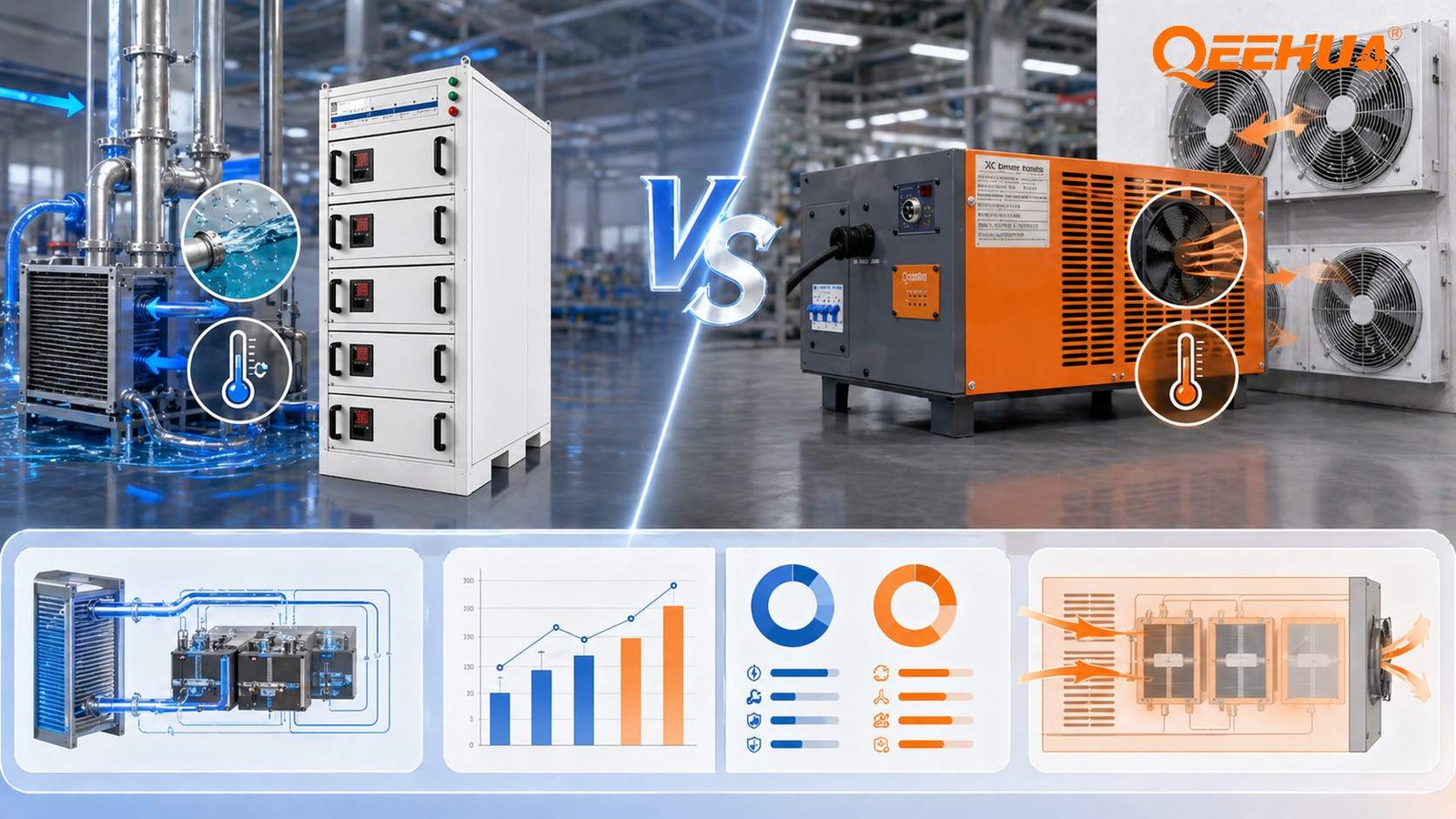
Air-cooled rectifiers rely on forced convection to transfer heat from power electronics to the surrounding environment. QEEHUA’s air-cooled product lines incorporate precision-balanced centrifugal fans, aluminum heat sinks with optimized fin geometry, and thermal sensors that modulate fan speed based on real-time temperature readings.
The thermal resistance pathway in air-cooled systems flows from semiconductor junctions to the baseplate, through thermal interface materials, into the extruded aluminum heatsink, and finally to ambient air. This design achieves thermal equilibrium through careful calculation of airflow requirements against power dissipation, with margins built in to accommodate elevated ambient temperatures common in unventilated workshop environments during summer months in the Pearl River Delta.
Air-cooled rectifiers typically operate reliably in ambient temperatures up to 40°C, with derating factors applied for operation beyond 35°C. For facilities with ambient conditions frequently exceeding these thresholds, active cooling enhancement through dedicated air conditioning or exhaust ventilation becomes necessary to maintain specified output capacity.
Water-Cooled Rectifier Systems
Water-cooled rectifiers employ liquid cooling circuits to achieve superior heat removal efficiency compared to air-based methods. QEEHUA’s water-cooled units incorporate sealed coolant loops with deionized water or specialized heat transfer fluids, variable-speed circulation pumps, and plate-type or tube-type heat exchangers that separate process cooling from electronic cooling circuits.
The thermal conductivity of water (approximately 0.6 W/m·K) significantly exceeds that of air (approximately 0.025 W/m·K), enabling equivalent heat transfer with smaller temperature differentials. This translates to lower semiconductor junction temperatures, extended component lifespan, and improved current stability during high-duty-cycle operations.
Water cooling enables continuous operation at full rated current without thermal derating, even in environments where air-cooled systems would require significant output reduction. This capability proves essential for automated plating lines running 24-hour shifts, where consistent power delivery directly impacts coating uniformity and production throughput.
Comparative Analysis for Electroplating Applications
Current Density Requirements
Electroplating processes demand specific current density ranges for acceptable coating quality. Decorative chromium plating typically requires 30-60 ASD, while hard chromium processes operate at 45-100 ASD. These parameters directly influence rectifier sizing and, consequently, cooling requirements.
For operations using current densities below 20 ASD with intermittent duty cycles (less than 60% operating time), air-cooled rectifiers provide cost-effective solutions without sacrificing performance. However, high-current-density processes operating at continuous duty approach the thermal limits of air-cooled designs, making water cooling the practical choice for consistent quality assurance.
QEEHUA’s application engineering team in Dongguan frequently consults with electroplating facilities running automated nickel and chrome plating lines. In these scenarios, water-cooled rectifiers with ratings of 2000A and above consistently demonstrate superior coating thickness uniformity and reduced reject rates compared to air-cooled alternatives operating at equivalent current densities.
Installation Environment Considerations
The physical installation environment significantly influences cooling technology suitability. Air-cooled rectifiers require adequate clearance around all sides for airflow circulation (minimum 300mm), clean ambient air free from conductive dusts and corrosive vapors, and sufficient workshop volume for heat dissipation.
For facilities in dense industrial zones of Shenzhen, Dongguan, and Guangzhou where workshop space comes at premium costs, air-cooled rectifiers positioned in confined spaces experience elevated ambient temperatures that degrade cooling efficiency. Water-cooled systems offer installation flexibility through compact form factors that can be mounted in equipment cabinets or positioned in space-constrained locations.
Corrosive environments present additional challenges for air-cooled systems. Chemical vapors from plating solutions, especially those containing sulfuric acid, hydrochloric acid, or chromic acid, accelerate corrosion of heatsink fins and fan bearings. Water-cooled designs isolate electronic components from workshop atmosphere through sealed enclosures, significantly extending service life in aggressive chemical environments common to metal finishing operations.
FAQ: Cooling System Selection
Q: What are the energy consumption differences between water-cooled and air-cooled rectifiers? A: Air-cooled systems consume power for fan motors (typically 50-200W depending on size), while water-cooled units require circulation pump power (typically 100-400W) plus heat exchanger fan power if external cooling towers are used. However, water-cooled rectifiers typically achieve 2-3% higher electrical efficiency due to reduced thermal resistance, often offsetting the cooling power consumption through improved overall system efficiency.
Q: How often do cooling systems require maintenance? A: Air-cooled rectifiers require quarterly inspection of fan bearings and heatsink cleaning to remove accumulated dust and chemical deposits. Water-cooled systems require semi-annual coolant replacement and annual inspection of pump seals and heat exchanger tubes. QEEHUA provides maintenance schedules optimized for South China’s humid climate, recommending more frequent coolant analysis in coastal facilities.
Q: Can air-cooled rectifiers be upgraded to water cooling? A: Generally, no—the cooling architecture is determined during manufacturing. Retrofitting would require complete internal redesign. Facilities anticipating future capacity expansion should select water-cooled models initially to accommodate growth without equipment replacement.
Q: What water quality is required for water-cooled rectifiers? A: QEEHUA specifies deionized water with conductivity below 5 μS/cm for closed-loop systems. Municipal water supplies in Guangdong provinces typically require pretreatment through reverse osmosis or ion exchange to meet these requirements. Local water treatment suppliers can provide appropriate filtration systems sized for specific coolant flow rates.
Q: Which cooling option offers better reliability for 24/7 operations? A: Water-cooled systems demonstrate superior mean time between failures (MTBF) for continuous-duty applications due to lower component stress temperatures. Air-cooled systems experience more frequent fan failures in dusty environments but offer simpler fault isolation. QEEHUA’s warranty data shows water-cooled rectifiers averaging 40% longer service intervals for production facilities running three or more shifts daily.
Total Cost of Ownership Comparison
Initial Investment Considerations
Water-cooled rectifiers command 25-40% higher initial purchase prices compared to equivalent air-cooled models due to additional components (pumps, heat exchangers, sealed enclosures) and manufacturing complexity. However, this premium often proves economical for high utilization scenarios where equipment runs more than 16 hours daily.
Air-cooled rectifiers offer lower entry costs, making them attractive for smaller operations, pilot production facilities, or applications with seasonal demand patterns. QEEHUA’s product specialists in the Pearl River Delta can provide detailed cost modeling based on specific production schedules and utility rates.
Operating Cost Implications
Energy efficiency differences between cooling technologies directly impact electricity expenditure. A 3000A rectifier operating continuously at full load experiences approximately 1,500 RMB annual electricity savings when equipped with water cooling rather than air cooling, based on current industrial electricity rates in Guangdong province.
Cooling system maintenance costs also favor water-cooled designs. Fan replacement for air-cooled systems averages 800-1500 RMB per event, with failures potentially causing cascading damage to semiconductors if thermal protection fails to activate promptly. Water-cooled pump rebuilds typically cost 500-1000 RMB and present lower risk of catastrophic failure.
Conclusion: Matching Technology to Application
The choice between water-cooled and air-cooled rectifiers ultimately depends on specific production requirements, operational patterns, and facility constraints. For South China’s electroplating industry, QEEHUA recommends water-cooled technology as the default choice for automated production lines, high-current-density processes, space-constrained installations, and corrosive environments. Air-cooled systems serve effectively for smaller operations, intermittent duty applications, and facilities with existing HVAC infrastructure capable of managing thermal loads.
Consultation with QEEHUA’s application engineers—available through regional offices in Dongguan, Suzhou, and Qingdao—provides facility-specific recommendations incorporating actual production parameters and local infrastructure considerations.