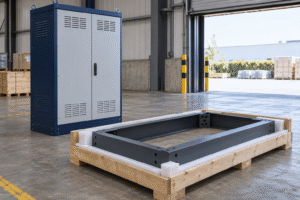
For rectifier crate moisture indicator delivery record, define the purchasing and acceptance boundary. Agree whether a moisture indicator is included in the rectifier shipping package and how its delivery condition will be recorded. A card observation belongs to a defined package and time, with its interpretation supplied by the responsible packing specialist. It does not independently establish the condition of every internal component. Procurement should connect the package specification, card identity and handover evidence before accepting a special protective-packing quotation.
Identify the proposed protective package
Ask the supplier whether the offer includes a barrier bag, indicator, desiccant or another confirmed packing arrangement. Keep each item explicit instead of treating export packing as a complete specification. Record the package revision and the cabinet identity. The cover illustration is conceptual and establishes no offered moisture protection. A buyer should obtain the actual proposal and its limitations before comparing the cost of special protection.

Agree the indicator record and interpretation
Request the indicator type, required observation point and interpretation guidance from the responsible packing party. Define who records its condition and links it with the package identifier. This article provides no universal color threshold or exposure limit. An unlabeled picture of a card from another shipment is not delivery evidence for this cabinet. Preserve the actual observation and any uncertainty without converting it into an unsupported equipment pass.
Retain package changes and handovers
Record an authorized opening, resealing or change of protective packing where the agreed procedure requires it. Connect carrier receipt, warehouse transfer and customer observation to the same package. If condition is uncertain, retain the evidence and ask the responsible supplier or technical party for disposition. Do not infer that a later replacement card reconstructs earlier conditions. Keep logistics observations separate from electrical inspection and commissioning acceptance.

Price an identified packing scope
Provide cabinet dimensions, destination, expected transport stages, storage responsibilities and required delivery evidence with the equipment RFQ. Ask QEEHUA to confirm the offered packing materials, documents and exclusions. Specify who reviews a condition deviation and which records accompany delivery. No storage duration, humidity resistance or device performance is guaranteed by this guide. The accepted packing proposal should remain connected to the actual equipment supply and project schedule.
Compare the proposed supply and its evidence
| Buyer need | Recommended product | Key specification | Why it matters |
|---|---|---|---|
| cabinet and protective-package identity | Identified industrial rectifier configuration | Order-specific scope and responsible reviewer | Connects the record to the item being purchased |
| indicator type and observation rule | Identified industrial rectifier configuration | Order-specific scope and responsible reviewer | Makes an important comparison condition visible |
| opening and handover history | Identified industrial rectifier configuration | Order-specific scope and responsible reviewer | Separates observation from an assumption |
| confirmed packing scope and disposition | Identified industrial rectifier configuration | Order-specific scope and responsible reviewer | Preserves the accepted delivery decision |
Best for defined industrial projects
Best for engineering teams, industrial purchasing managers and distributors preparing an identified industrial rectifier order. Suitable for a project with a documented application, quantity, technical owner and acceptance procedure. Not suitable for inferring a universal equipment capability, fixed commercial term or verified order result from a catalog image. Confirm the offered configuration and the project-specific evidence before approving production supply.
Buyer questions before requesting a quotation
What information should accompany the first RFQ?
Describe the application, destination, proposed configuration, quantity and target delivery date. Include the cabinet and protective-package identity and identify the person who owns technical approval. Send the relevant drawings, process information or specification revision when available. Ask the supplier to return a proposal that distinguishes confirmed requirements from assumptions, exclusions and options, so the industrial purchase can be reviewed against a clear scope.
Does a general catalog establish this acceptance requirement?
A general catalog provides product context and can help identify the family to discuss. It does not establish the indicator type and observation rule for the actual order. Ask the supplier to confirm the proposed arrangement and the evidence that will accompany it. Keep product identity, a requested feature, a completed demonstration and the final acceptance decision separate when assessing whether the requirement has been met.
Which documents should the buyer retain?
Retain the accepted technical offer, applicable configuration and revision identities, relevant inspection records and the delivery disposition. Preserve the opening and handover history together with any deviation and its review. The useful record connects an observation with the actual supplied item and requirement. An unrelated brochure, image or unconfirmed numerical claim should not replace the evidence specifically required for the project purchase.
Can the documentation and supply scope be customized?
Submit the requested documentation, packaging, identification or other supply change with the inquiry. Include the confirmed packing scope and disposition and explain the intended use. Ask QEEHUA to confirm feasibility, quantity conditions and the effect on price or delivery in the actual proposal. Keep the agreed revision with the order rather than assuming that every requested customization is standard or already included.
How should technical approval and delivery be scheduled?
Close the technical scope, approval owner and outstanding questions before requesting a firm production commitment. Include the cabinet and protective-package identity, required quantity, destination and target arrival date. Distinguish document review, any agreed evaluation, production completion and transportation. This guide establishes no inventory position, minimum order or fixed lead time; the supplier must confirm those commercial conditions for the actual configuration and project.
Send an identified industrial supply inquiry
For a quotation, provide the application, project country, required quantity, technical specifications, relevant drawings, testing requirements, packaging or OEM needs and target delivery schedule. Identify the unresolved acceptance questions and the person responsible for reviewing the proposal. Contact QEEHUA with the project details to request an actual technical and commercial offer. Keep a proposed value clearly labeled until it is confirmed for the supplied configuration.
Connect this review to the complete project specification
Provide the proposed output voltage and current, operating duty, cooling arrangement and control interface for the actual plating, anodizing or electrolysis application. Identify the installation environment and which party owns equipment integration. Ask the supplier to distinguish standard equipment from requested options and project services. A technical offer should connect its ratings and configuration references to the documents required by the customer. Keep a requested numerical limit separate from a value confirmed for the quoted model. The purchasing team should state quantity, destination, packaging and the required delivery sequence. If the plant layout or control scope changes, retain the revised proposal and obtain the relevant technical review. The acceptance discussion in this article addresses one defined supply interface; it does not establish that every cabinet in a product family includes the same configuration, documentation or service arrangement.