An IGBT electroplating rectifier is a high-frequency DC power supply that uses Insulated Gate Bipolar Transistors as switching devices to convert AC to ultra-stable DC for electroplating.
IGBT vs SCR Electroplating Rectifier: Which Should You Choose in 2026?
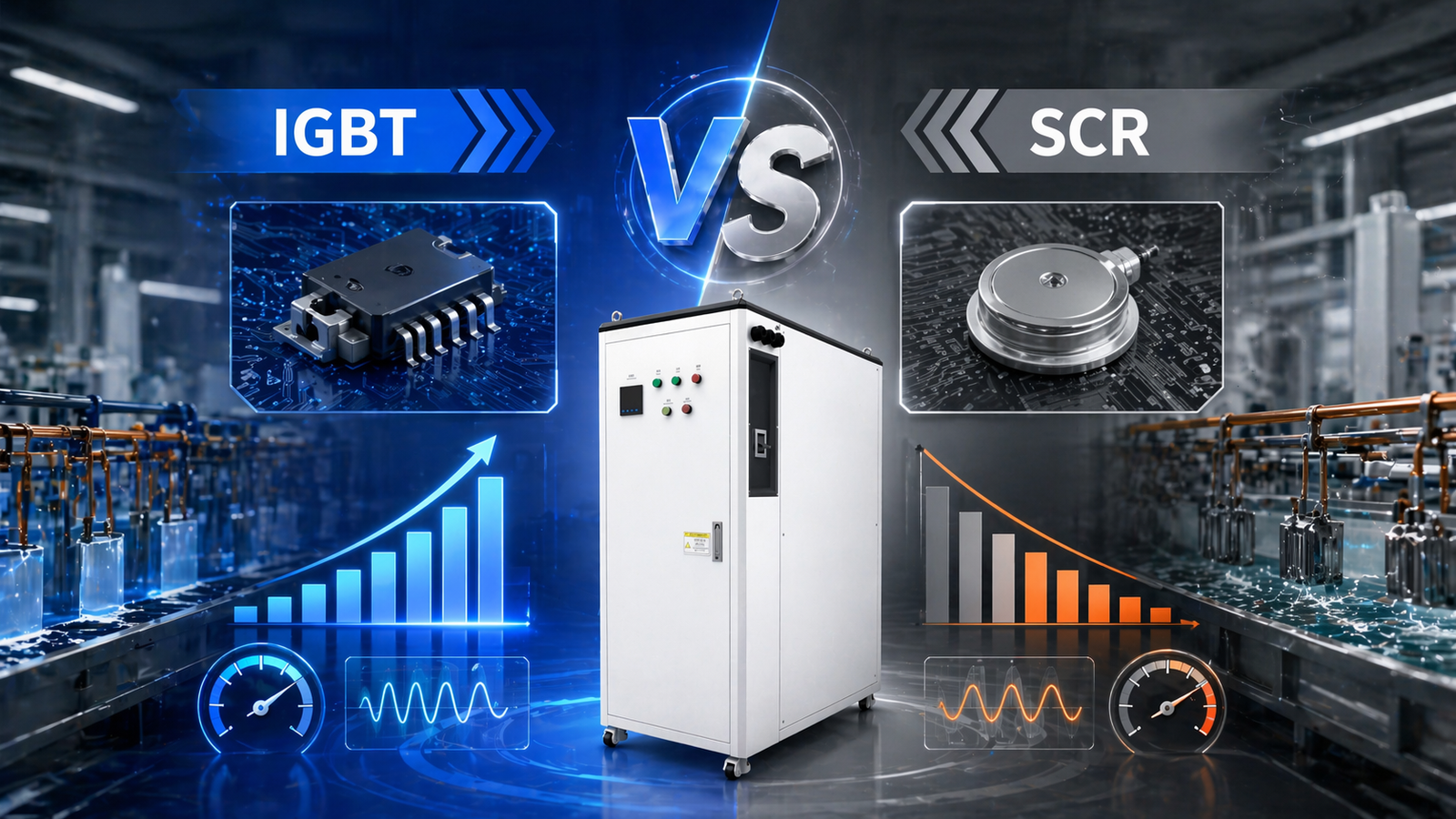
An IGBT electroplating rectifier is a high-frequency DC power supply that uses Insulated Gate Bipolar Transistors (IGBTs) as switching devices, converting AC mains power into precisely controlled, low-ripple DC current for electroplating processes. Unlike older SCR (Silicon-Controlled Rectifier) systems, IGBT rectifiers switch at 20–100 kHz, delivering superior current stability and efficiency.
The global IGBT electroplating rectifier market is growing at approximately 5.2% CAGR through 2032, driven by manufacturers upgrading from legacy SCR systems. In 2026, an estimated 60–70% of new electroplating installations globally specify IGBT technology — yet many existing production floors still run SCR units.
This guide gives you the data to make the right choice for your operation.
What Is an SCR (Silicon-Controlled Rectifier)?
An SCR rectifier — also called a thyristor rectifier — uses silicon-controlled rectifiers (thyristors) that switch at the AC line frequency (50 or 60 Hz). The thyristors fire in phase with the AC cycle, producing a pulsating DC output that is filtered to approximate a steady current.
SCR rectifiers dominated electroplating from the 1960s through the 2000s, and remain in service across thousands of installations due to their durability and low initial cost.
SCR Rectifier by the Numbers:
- Switching frequency: 50–60 Hz (line frequency)
- Efficiency: 75–85%
- Output ripple: 3–10%
- Typical weight (1,000A unit): 80–150 kg
- Typical lifespan: 15–25 years
What Is an IGBT High-Frequency Rectifier?
An IGBT high-frequency switching rectifier uses Insulated Gate Bipolar Transistors operating at 20,000–100,000 Hz. This high-frequency switching, combined with compact transformers and active filtering, produces a DC output with ripple under 1% — and often below 0.5%.
IGBT rectifiers became commercially viable for industrial use in the mid-1990s and now represent the dominant technology in new installations.
IGBT Rectifier by the Numbers:
- Switching frequency: 20,000–100,000 Hz
- Efficiency: 90–95%
- Output ripple: <1% (standard), <0.3% (precision models)
- Typical weight (1,000A unit): 20–45 kg
- Energy savings vs SCR: 15–30% at equivalent output
Head-to-Head Comparison
| Feature | SCR Rectifier | IGBT High-Frequency Rectifier |
|---|---|---|
| Switching Frequency | 50–60 Hz | 20,000–100,000 Hz |
| Efficiency | 75–85% | 90–95% |
| Output Ripple | 3–10% | <1% (standard), <0.3% (precision) |
| Current Response Time | 100–500 ms | 1–10 ms |
| Weight (1,000A unit) | 80–150 kg | 20–45 kg |
| Footprint | Large (transformer-heavy) | Compact |
| Upfront Cost | Lower ($800–$3,000 for 1,000A) | Higher ($1,500–$5,000 for 1,000A) |
| Energy Cost (annual, 1,000A×12V, 8,760h) | ~$1,310/yr | ~$1,050/yr (saving ~$260/yr) |
| Maintenance | More frequent (capacitor aging, transformer) | Less frequent (no brushes, fewer components) |
| Noise (acoustic) | Higher (transformer hum) | Lower |
| Pulse/Reverse Capability | Limited/complex | Built-in on many models |
| Digital Control | Retrofit possible | Standard |
| Certifications | CE available | CE standard |
Efficiency Deep Dive: Real Energy Cost Comparison
Efficiency differences translate directly into operating costs. Here’s a concrete example:
Scenario: 1,000A output at 12V DC, running 20 hours/day, 300 days/year
Energy price: $0.10/kWh
| Metric | SCR (80% eff.) | IGBT (92% eff.) |
|---|---|---|
| Output power | 12,000W | 12,000W |
| Input power required | 15,000W | 13,043W |
| Daily energy consumption | 300 kWh | 260.9 kWh |
| Annual energy consumption | 90,000 kWh | 78,260 kWh |
| Annual energy cost | $9,000 | $7,826 |
| Annual saving with IGBT | — | $1,174/year |
For a facility running 10 rectifiers at this scale, switching to IGBT saves approximately $11,740/year in electricity alone. At a price premium of $2,000 per unit, the upgrade pays back in under 2 years.
Ripple and Plating Quality: Why It Matters
Output ripple — the residual AC variation in the DC output — directly affects plating quality:
- High ripple (>5%): Coarse grain structure, porous deposits, poor adhesion, increased corrosion susceptibility
- Low ripple (<1%): Fine grain structure, dense deposits, superior surface finish, better corrosion resistance
Ripple requirements by application:
| Process | Required Ripple | SCR Adequate? | IGBT Required? |
|---|---|---|---|
| General zinc/nickel plating | <5% | ✅ Yes | Optional |
| Decorative chrome plating | <2% | ⚠️ Marginal | Recommended |
| Hard chrome plating | <1% | ❌ No | ✅ Yes |
| PCB copper plating | <1% | ❌ No | ✅ Yes |
| Semiconductor packaging | <0.5% | ❌ No | ✅ Yes (precision) |
| Anodizing (standard) | <3% | ✅ Yes | Optional |
| Hard anodizing | <1% | ❌ No | ✅ Yes |
Application-Specific Recommendations
Choose IGBT When:
- Chrome plating (hard or decorative) — low ripple is essential
- PCB and HDI copper plating — ultra-low ripple (<0.5%) required
- Anodizing with precise voltage ramp control
- New production line installation (TCO advantage)
- Pulse plating or reverse-pulse plating applications
- EV battery copper foil electrodeposition
- Semiconductor or advanced packaging plating
- You need remote monitoring / Industry 4.0 connectivity
Choose SCR When:
- Replacing existing SCR in a legacy installation (direct swap)
- Budget is the overriding constraint
- General zinc or nickel plating with relaxed quality requirements
- Very large electrowinning operations (>10,000A) where cost per amp is paramount
- Temporary or pilot-scale installations
Hybrid Approach:
Some manufacturers maintain SCR rectifiers for bulk/roughing stages while upgrading to IGBT for finishing stages — capturing quality benefits where they matter most.
Maintenance Comparison
SCR Rectifier Maintenance Schedule:
- Clean cooling fans and filters: Every 3 months
- Inspect thyristor connections: Every 6 months
- Test capacitor bank: Every 1–2 years
- Replace capacitor bank: Every 8–12 years (~$500–$2,000)
- Replace thyristor modules: As needed (~$200–$800 per module)
IGBT Rectifier Maintenance Schedule:
- Clean cooling fans and filters: Every 6 months
- Check IGBT module connections: Annually
- Inspect snubber capacitors: Every 2–3 years
- IGBT module replacement: Every 10–15 years typically
Verdict: IGBT requires 30–40% fewer maintenance interventions than SCR over a 10-year period, contributing to lower total ownership cost.
Frequently Asked Questions
What is the main difference between IGBT and SCR rectifiers?
The main difference is switching technology and frequency. SCR rectifiers switch at 50–60 Hz using thyristors, producing higher ripple (3–10%) and operating at 75–85% efficiency. IGBT rectifiers switch at 20,000–100,000 Hz, producing much lower ripple (<1%) and operating at 90–95% efficiency. IGBT units are more compact, more efficient, and better suited for precision plating applications.
Is an IGBT rectifier worth the higher upfront cost?
For most applications, yes. The energy savings of 15–30% typically pay back the price premium within 1–2 years. For precision applications (PCB, hard chrome, semiconductor), IGBT is not optional — SCR cannot meet the ripple specifications required.
Can I replace my SCR rectifier directly with an IGBT unit?
In most cases, yes. The DC output connections are compatible. You will need to match the voltage and current ratings, and update the control wiring if your line uses older analog interfaces. QEEHUA offers retrofit assessment consultations to verify compatibility.
What ripple does QEEHUA’s IGBT rectifier deliver?
QEEHUA standard IGBT models deliver ripple <1%. Precision models for PCB and semiconductor applications deliver <0.5%, and custom configurations for copper foil electrodeposition can achieve <0.3%.
How long do IGBT rectifiers last?
Well-maintained IGBT rectifiers typically have a service life of 15–20 years. IGBT modules themselves (the primary consumable) typically last 10–15 years under normal operating conditions. QEEHUA provides a 2-year standard warranty with optional extended service agreements.
What output range does QEEHUA offer?
QEEHUA manufactures IGBT rectifiers from 100A to 500,000A output current, with voltage ranges from 0V to 1,500V DC. Custom specifications are available for electrowinning, copper foil, and other high-power applications.
Summary: IGBT is the Right Choice for 2026
Key facts:
- IGBT rectifiers are 10–20 percentage points more efficient than SCR
- Ripple of <1% vs 3–10% for SCR — critical for plating quality
- 15–25 kg lighter per 1,000A unit vs 80–150 kg for SCR
- Energy savings of $1,000–$5,000/year per rectifier (scale-dependent)
- Payback period: typically 12–24 months
- 60–70% of new 2026 installations specify IGBT
For new installations, process upgrades, or quality improvement projects, IGBT high-frequency rectifiers are the clear technical and economic choice. SCR remains viable only for large-scale legacy replacements where exact compatibility is required.
QEEHUA’s full range of IGBT high-frequency synchronous rectifiers covers applications from 100A precision plating to 500KA copper foil electrodeposition — all CE certified, IoT-ready, and backed by global service support.