How to Choose the Right Electroplating Rectifier: A Complete Buyer’s Guide (2026)
Selecting the wrong electroplating rectifier can cost you in productivity, plating quality, and energy bills. With dozens of models on the market — air-cooled, water-cooled, IGBT, SCR, pulse, synchronous — the choice is far from obvious.
This guide walks you through every factor that matters: output power, cooling method, control precision, rectifier topology, and application-specific requirements. By the end, you’ll know exactly what to look for before making your purchase.
What Is an Electroplating Rectifier?
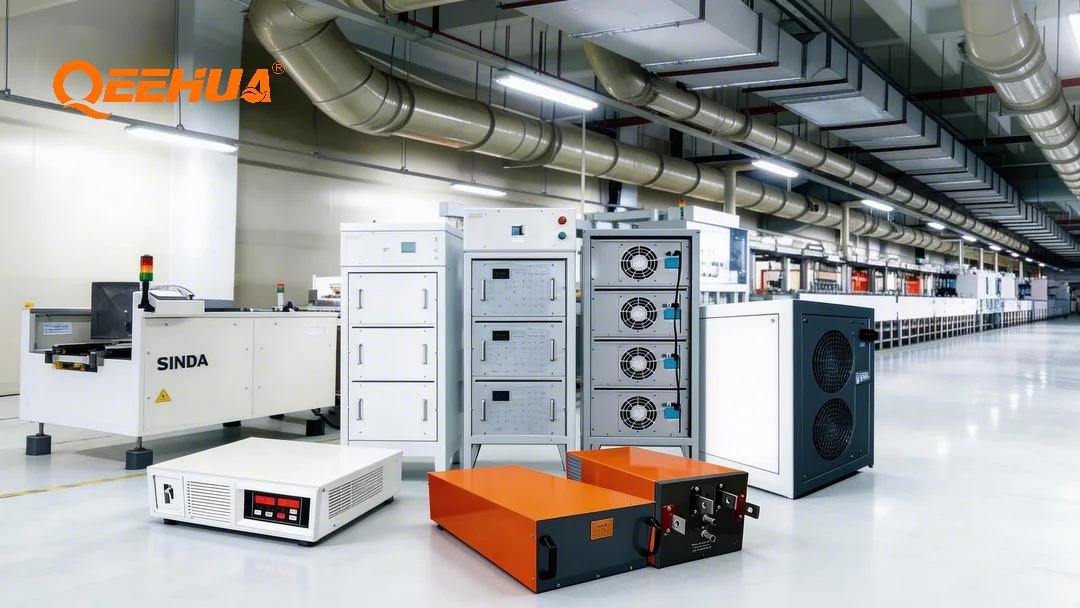
An electroplating rectifier is a specialized DC power supply that converts AC mains power into a stable, adjustable direct current (DC). This controlled current drives the electrochemical deposition of metal ions onto a substrate — whether you’re plating chrome onto automotive parts, copper onto PCB traces, or gold onto jewelry.
The quality of your plating depends directly on the quality of your rectifier. Unstable current causes uneven deposits, poor adhesion, and increased rejection rates.
Key Selection Criteria
1. Output Voltage and Current Requirements
Start by calculating your process requirements:
Voltage: Most electroplating applications operate between 6V and 24V DC. Chrome plating typically needs 6–12V. Anodizing aluminum may require up to 100V. Verify your process chemistry specifications first.
Current (Amperage): Calculated as:
Required Current (A) = Current Density (A/dm²) × Total Plating Area (dm²)
Add a 20–30% safety margin for peak loads and future capacity growth.
Example: A PCB line with 500 dm² of board surface at a current density of 2 A/dm² needs at least 1,000A — so specify a 1,200A or 1,500A rectifier.
2. Rectifier Topology: IGBT High-Frequency vs. SCR (Silicon-Controlled Rectifier)
This is the most critical technology decision.
| Feature | IGBT High-Frequency Rectifier | SCR (Thyristor) Rectifier |
|---|---|---|
| Efficiency | 90–95% | 75–85% |
| Ripple | < 1% (very low) | 3–10% |
| Response time | Milliseconds | Hundreds of milliseconds |
| Weight/Size | Compact, lightweight | Large, heavy |
| Noise | Low | Higher (transformer hum) |
| Cost | Higher upfront | Lower upfront |
| Maintenance | Less maintenance | More maintenance |
| Best for | Precision plating, PCB, pulse plating | Heavy industrial, electrowinning |
Verdict: For most modern applications — PCB, semiconductor, jewelry, automotive — an IGBT high-frequency rectifier is the clear choice. The energy savings (up to 30% vs. SCR) typically pay for the higher upfront cost within 12–18 months.
3. Cooling Method: Air vs. Water Cooling
Air-Cooled Rectifiers:
- Suitable for outputs up to ~3,000A
- Lower installation cost (no water infrastructure required)
- Works well in low-humidity, well-ventilated environments
- Easy maintenance
Water-Cooled Rectifiers:
- Required for outputs above 3,000A or in high-density production environments
- More stable operating temperatures → more stable output
- Essential for 24/7 continuous production
- Requires a closed-loop cooling water system
Rule of thumb: If your current exceeds 3,000A or your production runs continuously, choose water-cooled.
4. Plating Process Type
Different processes have different requirements:
Chrome Plating (Hard/Decorative):
- Requires very low ripple (< 2%)
- High current density capability
- Polarity reversal function is beneficial
- Recommended: IGBT rectifier with ripple < 1%
Anodizing:
- Wide voltage range (up to 100V for hard anodizing)
- Precise voltage ramp control
- Medium current density
- Recommended: IGBT rectifier with programmable voltage ramp
PCB / HDI Plating:
- Ultra-low ripple essential (< 0.5%)
- Pulse and reverse-pulse capability critical for HDI
- Remote monitoring and data logging for process control
- Recommended: Pulse IGBT rectifier with PLC/PROFINET interface
Zinc/Nickel/Copper General Plating:
- Standard IGBT high-frequency rectifier
- Moderate precision requirements
Electrowinning (Copper/Zinc/Gold):
- Very high current (10,000A+)
- High voltage stability
- Water-cooled mandatory
- Recommended: High-power synchronized IGBT rectifier
5. Control and Automation Features
Modern electroplating lines require smart power management. Look for:
- Digital control panel with precise A/V adjustment (0.1V / 0.1A resolution)
- Programmable timer for automatic current stepping
- Remote monitoring via RS485, Modbus, Ethernet, or PROFINET
- Data logging for process documentation and quality control
- AI/Smart optimization — advanced rectifiers (like QEEHUA’s QEKR series) use algorithms to maintain optimal current density in real-time
- Fault protection: overcurrent, overvoltage, overtemperature, short-circuit protection
6. Certifications and Standards
For export to Europe and North America, verify these certifications:
- CE marking (EU) — mandatory for European markets
- UL or ETL listing (North America)
- ISO 9001 — quality management certification
- RoHS compliance — restriction of hazardous substances
Do not purchase industrial-grade rectifiers without CE certification if selling into regulated markets.
7. Ripple Factor
Ripple is the residual AC variation in the DC output. High ripple causes:
- Rough, grainy plating texture
- Poor coating density
- Increased porosity and corrosion susceptibility
Acceptable ripple levels by application:
| Application | Maximum Ripple |
|---|---|
| General industrial plating | < 5% |
| Decorative chrome | < 2% |
| PCB copper plating | < 1% |
| Semiconductor / precision | < 0.5% |
| Pulse plating | Controlled pulse waveform |
8. Total Cost of Ownership (TCO)
Don’t judge only on purchase price. Calculate:
TCO = Purchase Price + (Annual Energy Cost × Years) + Maintenance Costs
A high-efficiency IGBT rectifier costing $8,000 may save $3,000/year in electricity vs. an SCR unit costing $5,000. Break-even: 1 year.
Energy cost example:
- 1,000A × 12V = 12kW output
- At 90% efficiency: 13.3kW consumed
- At 80% efficiency (SCR): 15kW consumed
- Difference: 1.7kW × 8,760 hours × $0.10/kWh = $1,489/year savings with IGBT
Quick Selection Checklist
Before contacting a manufacturer, have these specs ready:
- Required output voltage (V) and current (A)
- Process type (chrome, anodizing, PCB, zinc, etc.)
- Operating hours per day
- Ambient temperature and humidity at installation site
- Required certifications (CE, UL, etc.)
- Control interface required (standalone / PLC / Modbus / PROFINET)
- Space and weight constraints
- Budget range
Frequently Asked Questions
Q: What’s the difference between a rectifier and a power supply?
A: In electroplating, these terms are often used interchangeably. A rectifier specifically converts AC to DC. A “plating power supply” typically includes a rectifier plus filtering, control, and protection circuits — making it a complete industrial DC power source.
Q: Can I use a standard DC power supply for electroplating?
A: Not for industrial applications. Laboratory bench supplies lack the current capacity, ripple filtering, and continuous-duty ratings required for production plating.
Q: How often should an electroplating rectifier be serviced?
A: Air-cooled units: clean filters every 3–6 months. Check connections annually. Water-cooled units: inspect cooling water quality every 6 months. Modern IGBT rectifiers typically require less maintenance than older SCR units.
Q: What causes rectifier output instability?
A: Common causes include loose connections, degraded capacitors, overheating, input voltage fluctuations, and aging IGBT modules. Contact your manufacturer for diagnostics.
Conclusion
Choosing the right electroplating rectifier comes down to matching output specs to your process, selecting the right topology (IGBT for most modern applications), and planning for long-term efficiency. Investing in a quality high-frequency IGBT rectifier with smart control features pays dividends in plating quality, energy savings, and production reliability.
QEEHUA manufactures a full range of industrial electroplating rectifiers — from compact 100A PCB models to high-power 12,000A water-cooled units — all with CE certification and global after-sales support.