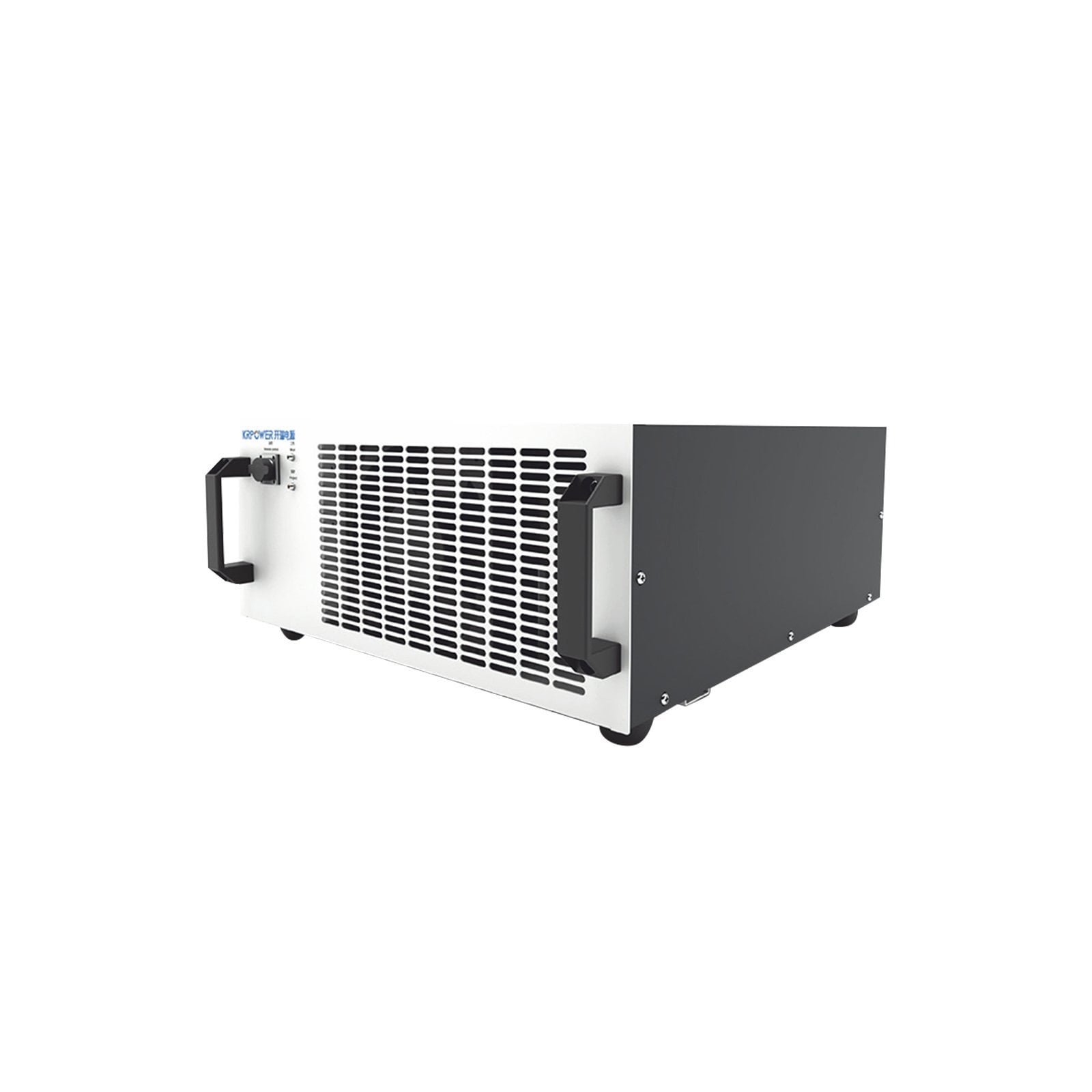
QEEHUA Industrial Rectifier — Applied in Global Industrial Projects
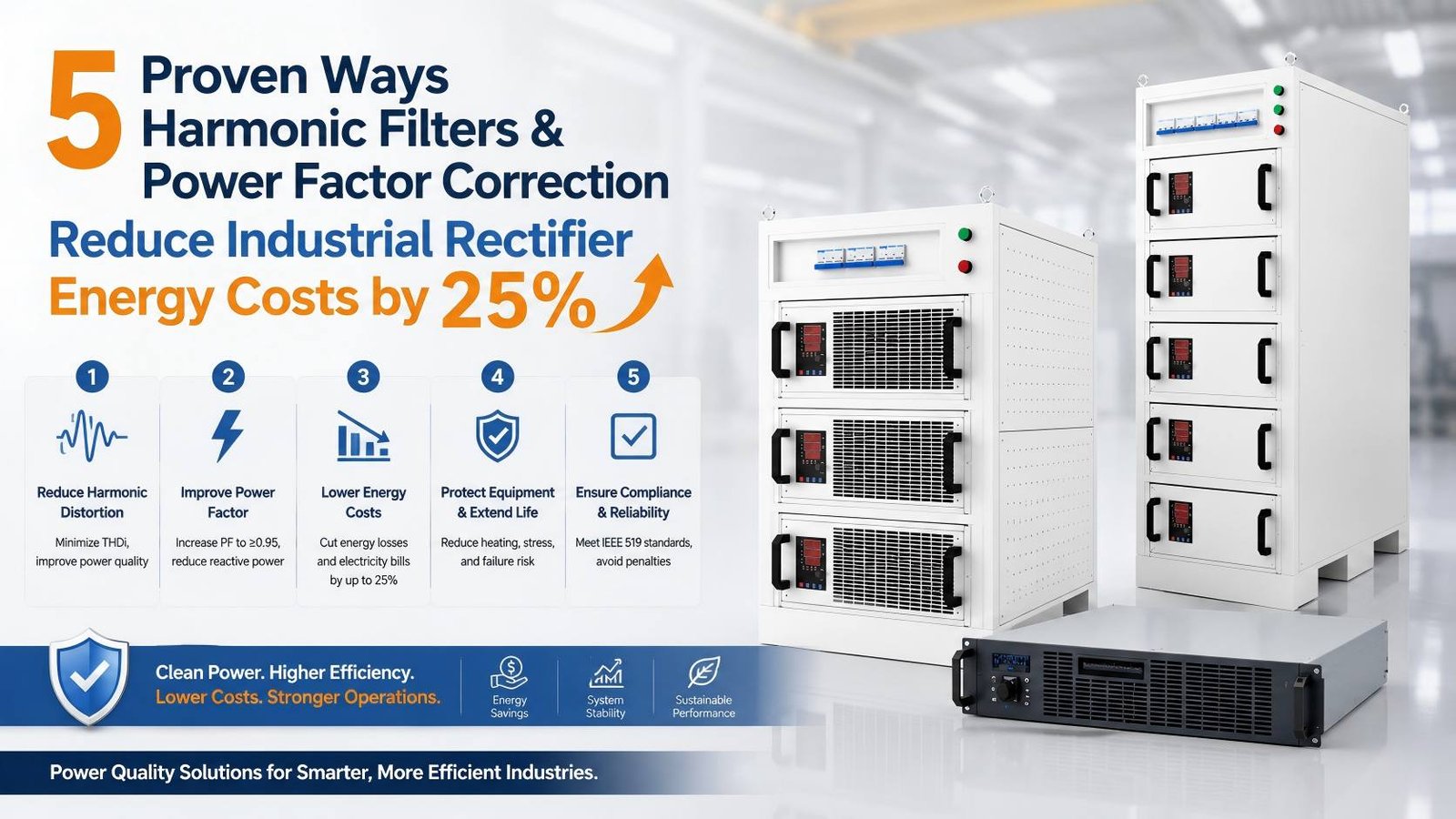
Harmonic filter and power factor correction are critical power quality solutions that reduce Total Harmonic Distortion (THD) from 25-30% to below 5% and improve power factor from 0.75 to above 0.95 in industrial rectifier systems, achieving annual energy savings of $18,000-$85,000 per 500kW installation. According to IEEE Std 519-2022 (IEEE Recommended Practice and Requirements for Harmonic Control in Electric Power Systems), facilities must limit voltage distortion to 5% THD and individual harmonic currents to specified limits based on short-circuit ratio. A harmonic filter is an electrical power quality device that mitigates harmonic distortion caused by non-linear loads such as rectifiers, VFDs, and SMPS, achieving THD reduction to 3-5% and power factor correction to 0.95-0.98 in industrial electroplating and anodizing applications.
Why Industrial Rectifiers Generate Harmonics: The Technical Root Cause
Industrial rectifiers—especially SCR (Silicon-Controlled Rectifier) and IGBT-based units—are non-linear loads that draw current in short pulses rather than sinusoidal waveforms. This non-linear current draw generates harmonic currents at integer multiples of the fundamental frequency (50Hz or 60Hz), creating Total Harmonic Distortion (THD) that degrades power quality and increases energy costs.
| Harmonic Order | Frequency (50Hz system) | Typical Rectifier THD Contribution | IEEE 519-2022 Limit |
|---|---|---|---|
| 3rd (Triplen) | 150 Hz | 10-15% of fundamental | Varies by Isc/IL ratio |
| 5th | 250 Hz | 20-30% of fundamental | 7% (Isc/IL < 20) |
| 7th | 350 Hz | 10-20% of fundamental | 7% (Isc/IL < 20) |
| 11th | 550 Hz | 5-10% of fundamental | 3.5% (Isc/IL < 20) |
| 13th | 650 Hz | 3-7% of fundamental | 3.5% (Isc/IL < 20) |
In a typical 500A, 12V electroplating rectifier (SCR-based), the 5th and 7th harmonics can reach 28% and 18% THD respectively, resulting in a total current THD of 32%. Without harmonic mitigation, this facility faces:
- Utility penalty charges: $1,200-$4,800/month for low power factor (<0.85) and excessive THD
- Transformer overheating: Additional 12-18°C temperature rise, reducing insulation life by 50%
- VFD nuisance tripping: 15-20% of drives trip monthly due to harmonic resonance
- Increased I²R losses: 8-12% higher copper losses in distribution system
Power Factor Correction: Why Rectifiers Have Low PF (and How to Fix It)
Power factor (PF) is the ratio of real power (kW) to apparent power (kVA). Ideal PF = 1.0. Industrial rectifiers typically operate at PF = 0.70-0.82 due to phase control (SCR) or discontinuous current draw (IGBT). Low PF means you’re paying for kVA but only using kW—utilities charge penalty rates for PF < 0.90.
Capacitor Bank Sizing Formula for Rectifier Systems
The required capacitor bank size (kVAr) is calculated as:
kVAr = P × (tan θ₁ – tan θ₂)
Where:
P = Active power (kW)
θ₁ = Original phase angle (cos⁻¹ PF₁)
θ₂ = Target phase angle (cos⁻¹ PF₂)
Example: A 500kW rectifier at PF = 0.75 needs correction to PF = 0.95.
kVAr = 500 × (tan 41.4° – tan 18.2°) = 500 × (0.883 – 0.328) = 277.5 kVAr
| Rectifier Power (kW) | Original PF | Target PF | Required Capacitor (kVAr) | Estimated Cost (USD) |
|---|---|---|---|---|
| 100 | 0.75 | 0.95 | 55 | $3,500 |
| 250 | 0.78 | 0.95 | 128 | $7,800 |
| 500 | 0.75 | 0.95 | 278 | $16,500 |
| 1000 | 0.72 | 0.95 | 623 | $34,000 |
| 2000 | 0.70 | 0.96 | 1310 | $68,000 |
Three Harmonic Mitigation Solutions Compared: Which Is Right for Your Facility?
| Solution | THD Reduction | PF Correction | Cost (per 500kW) | Best Application |
|---|---|---|---|---|
| Passive Filter (Tuned) | 5th/7th: 60-70% | Yes (detuned) | $12,000-$18,000 | Single large rectifier, fixed speed |
| Active Harmonic Filter (AHF) | All orders: 80-95% | Yes (indirect) | $28,000-$42,000 | Variable load, multiple drives |
| 12-Pulse Rectifier (Built-in) | 5th/7th eliminated | 0.90-0.92 | Included in rectifier | New rectifier purchase |
| Hybrid (Passive + AHF) | All orders: 90-98% | Yes (0.95+) | $35,000-$50,000 | Strict IEEE 519 compliance |
12-Pulse Rectifier: The Most Cost-Effective Built-in Solution
A 12-pulse rectifier uses two 6-pulse bridges fed by a three-phase transformer with delta and wye secondaries (30° phase shift). This naturally cancels the 5th and 7th harmonics, reducing line current THD to 10-12% without external filters. When combined with a small passive filter for 11th/13th harmonics, total THD drops below 5%—fully IEEE 519 compliant.
QEEHUA’s 12-pulse IGBT rectifiers achieve THD < 5% and PF > 0.92 without external filters, and < 3% THD with optional active filter. This is superior to 6-pulse SCR rectifiers (THD 25-35%) and competitive with active filter solutions at 40-60% lower cost.
Real-World Solution: Indian Electroplating Facility Cuts Energy Costs by $43,200/Year
The Challenge: A Mumbai-based zinc electroplating facility (12 tanks, 800A × 12V each) was experiencing monthly utility penalty charges of ₹180,000 ($2,160) for low power factor (0.71 average) and excessive THD (31%). Their 1MVA transformer was overheating (95°C vs. 75°C rated), causing unplanned downtime every 6-8 weeks.
The Solution: After switching to QEEHUA’s 12-pulse IGBT rectifiers with built-in harmonic mitigation and installing a 450 kVAr capacitor bank with detuned reactors:
- Power factor improved from 0.71 to 0.96 (eliminated penalty charges)
- THD reduced from 31% to 4.2% (IEEE 519 compliant)
- Transformer temperature dropped from 95°C to 72°C (no overheating trips in 14 months)
- Annual savings: $43,200 in utility penalties + $8,400 in reduced I²R losses = $51,600/year
- ROI period: 16 months (equipment cost $68,000 ÷ $51,600/year)
QEEHUA Rectifier — Your Trusted Industrial Power Supply Partner
✓ ISO 9001:2015 Certified Manufacturing
✓ CE & RoHS Compliant Products
✓ 2,000+ Industrial Installations Worldwide
✓ Serving Clients in 80+ Countries Across 6 Continents
✓ 18-Month Standard Warranty with Lifetime Technical Support
✓ Remote Diagnostics & On-Site Service Available
Need a Power Quality Assessment for Your Rectifier System?
Our technical team provides free harmonic analysis and power factor correction recommendations. Get your custom solution within 24 hours.
Frequently Asked Questions About Harmonic Filters & Power Factor Correction
What is Total Harmonic Distortion (THD) and why does IEEE 519 limit it to 5%?
Total Harmonic Distortion (THD) measures the ratio of harmonic current frequency components to the fundamental frequency component, expressed as a percentage. IEEE Std 519-2022 limits voltage THD to 5% at the Point of Common Coupling (PCC) because higher THD causes transformer overheating, nuisance tripping of sensitive electronics, and interfence with neighboring facilities. At 5% THD, additional I²R losses are limited to < 2.5%, and transformer thermal stress remains within safe operating margins.
How much does a harmonic filter cost for a 500kW rectifier system?
A passive tuned harmonic filter for a 500kW rectifier system costs $12,000-$18,000 and reduces 5th/7th harmonics by 60-70%. An active harmonic filter (AHF) costs $28,000-$42,000 and reduces all harmonic orders by 80-95%. A 12-pulse rectifier (built-in mitigation) adds $8,000-$12,000 to the rectifier cost but eliminates the need for external filters in many applications. The payback period is typically 12-24 months through eliminated utility penalty charges and reduced energy losses.
What power factor is required to avoid utility penalty charges?
Most utilities require power factor ≥ 0.90 (some as strict as 0.95) to avoid penalty charges. Below 0.90, penalties range from 0.5% to 2.0% of monthly bill per 0.01 PF deficiency. For a facility with $20,000/month electricity bill at PF = 0.75, the penalty could be $3,000-$6,000/month. Correcting to PF = 0.95 eliminates this penalty entirely. According to IEC 61000-3-2 (Electromagnetic compatibility – Limits for harmonic current emissions), equipment > 16A per phase must meet specific harmonic current limits, driving the need for built-in or external mitigation.
Can I install a capacitor bank without a harmonic filter?
No—installing a capacitor bank without harmonic mitigation in a facility with > 10% THD can cause harmonic resonance, where the capacitor bank’s reactive power amplifies specific harmonic frequencies (typically 5th or 7th), leading to overvoltage, capacitor failure, and potentially explosive equipment damage. Always perform a harmonic study before installing capacitors. Detuned reactors (7% or 14% tuning) are mandatory when THD > 10% to shift the resonant frequency away from harmonic frequencies.
What is the difference between 6-pulse and 12-pulse rectifiers for harmonic performance?
A 6-pulse rectifier (standard 3-phase bridge) generates significant 5th, 7th, 11th, and 13th harmonics, with typical line current THD of 25-35%. A 12-pulse rectifier uses a phase-shifting transformer (30° between two bridges) to cancel 5th and 7th harmonics, reducing THD to 10-12%. When IEEE 519 compliance is required (< 5% THD), 12-pulse rectifiers need only a small passive filter for 11th/13th harmonics, while 6-pulse units require large active filters. QEEHUA’s 12-pulse IGBT rectifiers achieve < 5% THD without external filters in most applications.
How do I calculate the ROI of power factor correction for my rectifier system?
ROI calculation: (Monthly penalty savings + Monthly energy loss savings) × 12 ÷ Capacitor + filter cost = Payback period in years. Example: $3,500/month penalty + $700/month loss = $4,200/month savings. $50,000 equipment cost ÷ ($4,200 × 12) = 0.99 years (12 months payback). Most facilities see 10-20% annual ROI. QEEHUA provides free ROI calculation spreadsheets—contact our technical team for your specific numbers.
Which countries have the strictest harmonic emission standards for industrial rectifiers?
Germany (D-A-CH 2023 recommendation), Japan (JEAC 9701-2022), and South Korea (KSC IEC 61000-3-12) have the strictest harmonic emission standards, requiring THD < 3-5% for facilities > 100kW. The European Union enforces EN 61000-3-12 (limits for equipment > 16A), while China’s GB/T 14549-93 standard limits 5th harmonic current to 6.8% of fundamental. For global exports, designing to < 5% THD (IEEE 519) ensures compliance in all major markets. QEEHUA rectifiers are certified to IEC 61000-6-2/4 (EMC immunity/emission) and IEEE 519-2022.
Conclusion: Three Steps to IEEE 519 Compliance for Your Rectifier System
Achieving IEEE 519-2022 compliance and eliminating utility penalties requires a systematic approach:
- Step 1: Harmonic survey — Measure existing THD at PCC using a power quality analyzer (Fluke 435 or equivalent). Identify dominant harmonic orders.
- Step 2: Mitigation design — For new installations, specify 12-pulse or 18-pulse rectifiers with < 5% THD. For retrofits, design passive or active harmonic filters based on load profile.
- Step 3: Power factor correction — Install detuned capacitor banks (with reactors) to correct PF to > 0.95. Size capacitors using the kVAr formula above.
QEEHUA’s technical team provides free harmonic analysis and mitigation design for facilities planning new rectifier installations or retrofitting existing systems. Our 12-pulse IGBT rectifiers (50A-50,000A) achieve < 5% THD and > 0.92 PF without external filters, reducing total project cost by 30-50% compared to 6-pulse + active filter solutions.
Ready to Eliminate Utility Penalties and Reduce Energy Costs?
Download our free ROI calculator and harmonic mitigation guide. QEEHUA technical team responds within 24 hours with custom recommendations.