Every lithium-ion battery cell contains a copper foil current collector — a continuous metallic sheet typically 6–12 micrometers thick. For a single electric vehicle battery pack with 100+ kWh capacity, that translates to hundreds of square meters of precisely manufactured copper foil.
Behind every roll of that foil is an electrodeposition process — and behind that process is a high-power, precision rectifier.
As global EV production surges past 40 million vehicles annually, copper foil manufacturing capacity is under enormous pressure. Rectifier technology is a critical bottleneck — and upgrading to modern high-frequency IGBT systems is how manufacturers stay competitive.
Why Copper Foil Quality Starts with the Rectifier
Copper foil for lithium battery applications is not commodity material. The specifications are demanding:
| Parameter | Specification |
|---|---|
| Thickness uniformity | ±0.5 µm across full width (up to 1,500mm) |
| Surface roughness (Rz) | < 1.0 µm (smooth side) |
| Tensile strength | > 30 MPa |
| Elongation | > 3% |
| Pinhole density | Zero tolerance |
Any deviation from these specs directly affects battery performance: uneven foil causes inconsistent lithium-ion intercalation, reducing energy density and cycle life. Pinhole defects can cause internal short circuits — a serious safety risk.
The rectifier’s role: Current uniformity across the cathode drum surface determines foil thickness consistency. Current ripple affects crystal structure and surface roughness. Current stability over time determines yield rate across multi-hour production runs.
Electrodeposition Process Overview
Copper foil is produced by continuous electrodeposition on a rotating titanium drum cathode:
- Copper sulfate electrolyte fills the plating cell
- Titanium drum cathode rotates continuously through the bath
- High-current DC power (supplied by rectifier) drives copper deposition onto the drum surface
- Foil is continuously peeled from the drum and wound onto rolls
Typical electrical requirements:
- Output voltage: 8–14V DC
- Output current: 10,000A – 50,000A (depending on drum size and production speed)
- Current density: 40–80 A/dm²
- Ripple requirement: < 0.5%
- Stability: ±0.1% over 24-hour continuous operation
These are among the most demanding rectifier specifications in any industrial application.
Rectifier Requirements for Battery-Grade Copper Foil
1. Ultra-High Current Output
Modern copper foil lines require 10,000A to 50,000A per drum. This demands:
- Water-cooled IGBT modules — Air cooling is insufficient at this power level
- Parallel module architecture — Multiple IGBT stages in parallel, with load-sharing control
- Busbars rated for continuous full load — Thermal management is critical at these current levels
2. Extremely Low Ripple
Current ripple above 0.5% causes:
- Microscopic surface waviness on the copper foil
- Reduced tensile strength (columnar grain structure disrupted)
- Increased rejection rate in battery cell assembly
High-frequency IGBT rectifiers (operating at 20–100 kHz switching frequency) achieve ripple < 0.5% — impossible with SCR-based systems.
3. Cross-Width Uniformity Control
A 1,500mm wide drum requires equal current density across its entire width. Advanced systems use:
- Multi-zone anode segmentation — Independent current zones across drum width
- Sensor-feedback control — Eddy-current or optical thickness sensors provide real-time feedback
- Closed-loop uniformity correction — Rectifier adjusts zone currents to compensate for measured variations
4. Long-Duration Stability
Copper foil production runs are measured in hours. A 24-hour run must maintain output stability within ±0.1% — far beyond what manually operated systems can achieve. Digital control with temperature-compensated feedback is essential.
5. Energy Efficiency
A 30,000A × 12V rectifier delivers 360kW of output. At 90% efficiency, input power is 400kW. Running 24/7/365:
Annual energy = 400kW × 8,760 hours = 3,504 MWh/year
At $0.08/kWh = $280,000/year per rectifier
With 10 rectifiers on a production floor, energy cost reaches $2.8 million/year. A 5% efficiency improvement = $140,000/year savings. This makes high-efficiency IGBT rectifiers an economic imperative, not a luxury.
Competitive Landscape: What Battery Manufacturers Need from Suppliers
Leading copper foil manufacturers (Furukawa Electric, Mitsui Mining, JX Nippon, Lingbao Gold, Nuode Holdings) are expanding capacity aggressively. Their supplier requirements for rectifier equipment typically include:
- Output current: customizable up to 50,000A
- Voltage: 8–18V DC, continuously adjustable
- Ripple: < 0.5% (0.3% preferred for ultra-thin foil)
- Efficiency: ≥ 92%
- Control: PLC interface (Siemens S7 / Mitsubishi / Rockwell)
- Data logging: continuous current/voltage/temperature recording
- Remote monitoring: Ethernet / 4G
- Certifications: CE, ISO 9001
- Cooling: closed-loop water cooling, inlet water ≤ 30°C
- MTBF: > 50,000 hours
- Delivery: support FAT (Factory Acceptance Test) before shipment
Beyond Copper Foil: Other EV Battery Electroplating Applications
QEEHUA rectifiers support multiple electroplating processes throughout EV manufacturing:
Nickel Plating on Battery Cell Casings
- Steel cell cans require nickel plating for corrosion resistance and weldability
- 10,000–30,000A @ 6–9V
- Continuous barrel plating or rack plating
Copper/Tin Plating on Battery Tabs and Bus Bars
- Copper tabs and aluminum bus bars require plating for conductivity and solderability
- 1,000–5,000A @ 6–12V
- High precision, selective area plating
Gold/Silver Plating on EV Connector Pins
- High-reliability connector contacts for BMS (Battery Management System)
- 100–500A @ 4–8V
- Very low ripple, precise thickness control
Zinc-Nickel Plating on EV Chassis Components
- Anti-corrosion coating replacing traditional zinc
- 5,000–20,000A @ 6–12V
- Alloy composition control (Ni 12–15%)
QEEHUA Solutions for EV Battery Manufacturing
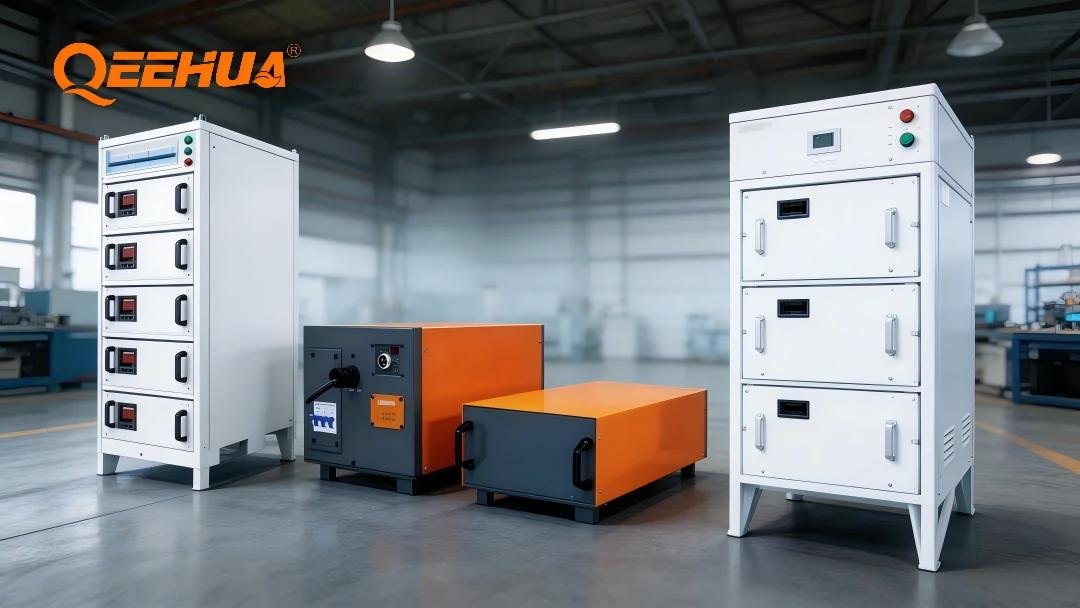
QEEHUA’s high-power synchronous rectifier series is engineered for the demanding requirements of battery manufacturing:
QEKR-Series High-Frequency Synchronous Rectifier:
- Output: 100A–50,000A (customizable)
- Voltage: 4–100V DC (customizable)
- Efficiency: ≥ 93%
- Ripple: < 0.5% standard, < 0.3% available on request
- Cooling: Water-cooled standard above 5,000A
- Interface: Modbus / PROFINET / EtherNet/IP
- Certifications: CE, ISO 9001
- Data logging: Continuous, 90-day local storage
- Remote monitoring: Cloud dashboard included
QE-SYHD-W Dual Water-Cooled Synchronous Rectifier:
- Designed for PCB and battery foil applications
- Dual-output independent control
- Load-sharing architecture for >20,000A configurations
- Integrated uniformity compensation
Market Outlook: Rectifier Demand in EV Supply Chain
Global EV production is projected to reach 40 million vehicles by 2030. Each vehicle requires approximately:
- 200g–400g copper foil (cell collector foil)
- 50g–150g various plated copper/nickel components
Total copper foil demand forecast: 1.5 million metric tons by 2030, requiring massive new electrodeposition capacity — and massive new rectifier installations.
The global plating rectifier market is valued at $490M in 2025, growing to $653M by 2033 (CAGR 3.7%). EV-driven demand is expected to accelerate this significantly in the 2026–2030 period.
For rectifier manufacturers with the technical capability to meet battery-grade specifications, the EV battery supply chain represents a significant and growing opportunity.
Frequently Asked Questions
Q: What is the difference between battery-grade copper foil rectifiers and standard electroplating rectifiers?
A: Battery-grade applications require significantly lower ripple (< 0.5% vs. 2–5% for general plating), higher current outputs (10,000A+), longer continuous-duty ratings, and tighter long-term stability specifications. Not all rectifier manufacturers can meet these requirements.
Q: Can a 5,000A rectifier be used for copper foil electrodeposition?
A: Only for small-scale laboratory or pilot production. Commercial copper foil lines typically require 15,000A–50,000A per drum. Multiple smaller rectifiers in parallel are possible but require active load-sharing control to maintain uniformity.
Q: How is foil thickness uniformity controlled?
A: Advanced systems use segmented anodes with independent current control per zone, combined with real-time thickness sensors (eddy-current or optical) providing feedback to the rectifier control system. QEEHUA’s QEKR series supports multi-zone output for this application.
Q: What warranty and after-sales support does QEEHUA offer for EV customer applications?
A: QEEHUA offers 2-year standard warranty with optional extended service agreements. Remote diagnosis capability enables fast response without on-site visits. Global service network covers major manufacturing regions in China, Southeast Asia, Europe, and North America.
Conclusion
The EV battery revolution is fundamentally a manufacturing challenge, and copper foil electrodeposition is at its heart. High-performance IGBT rectifiers — delivering ultra-low ripple, massive current output, and intelligent process control — are not optional equipment for battery manufacturers: they are production-critical infrastructure.
QEEHUA’s engineering team works directly with copper foil manufacturers and EV battery cell makers to specify, test, and deliver rectifier solutions optimized for battery-grade production requirements.