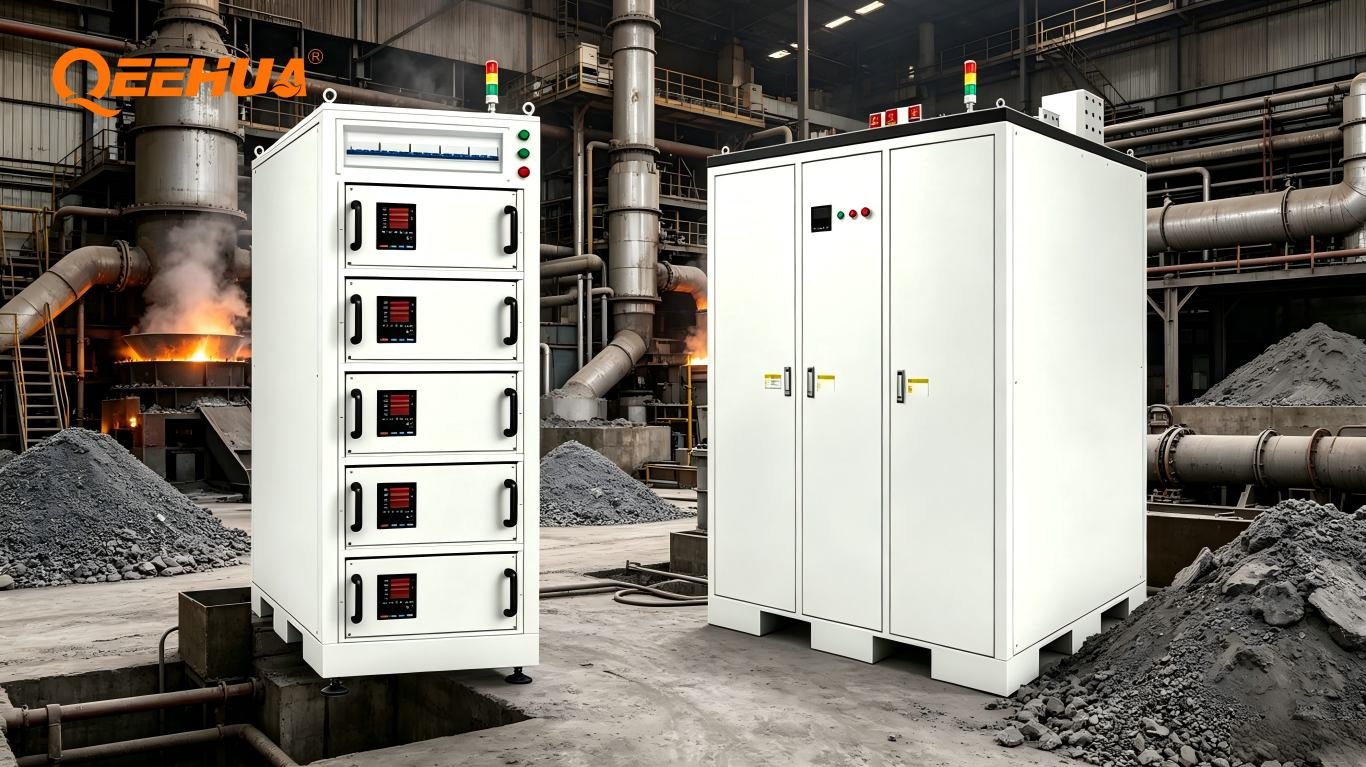
Rare earth electrolysis DC power supply is a high-current, low-voltage rectifier system designed for molten salt electrolysis processes that produce neodymium (Nd), praseodymium (Pr), dysprosium (Dy), and other rare earth metals, operating at 800-1200°C with 5,000-50,000A DC current and requiring <2% current stability to maintain molten salt chemistry and product purity (>99.5% Nd/Pr metal).
According to IEEE Std 844-2023, rare earth electrolysis power systems must provide <2% current ripple and <1% voltage regulation in molten salt environments (>800°C) to prevent dendritic growth, anode effect, and fluorine gas evolution that degrade product quality and cell life.
Rare Earth Electrolysis Process Fundamentals
Rare earth metals (Nd, Pr, Dy, Tb, La, Ce) are produced by molten salt electrolysis using fluoride or chloride salts at 800-1200°C. The electrolysis cell (also called electrowinning cell) contains:
- Cathode: Liquid rare earth metal pool (collects product)
- Anode: Carbon (graphite) or inert metal oxide
- Electrolyte: Molten fluoride salts (NdF₃-LiF, REF₃-LiF systems)
- Operating Temp: 800-1200°C (depends on metal)
The DC power supply must deliver stable low-voltage (5-50V) and very high current (5,000-80,000A) to drive the electrolysis reaction while maintaining precise current control to avoid cell instabilities.
Power Supply Specifications by Rare Earth Metal
| Rare Earth Metal | Cell Voltage | Current Range | Operating Temp | Current Density | Purity Achievable |
|---|---|---|---|---|---|
| Neodymium (Nd) | 8-15V | 10,000-50,000A | 1,000-1,050°C | 1.5-3.0 A/cm² | 99.5-99.9% |
| Praseodymium (Pr) | 8-15V | 10,000-40,000A | 1,000-1,050°C | 1.5-3.0 A/cm² | 99.5-99.9% |
| Dysprosium (Dy) | 10-18V | 5,000-30,000A | 1,100-1,200°C | 1.0-2.5 A/cm² | 99.0-99.5% |
| Terbium (Tb) | 10-18V | 5,000-25,000A | 1,100-1,200°C | 1.0-2.5 A/cm² | 99.0-99.5% |
| Lanthanum (La) | 6-12V | 8,000-40,000A | 850-950°C | 1.2-2.8 A/cm² | 99.0-99.5% |
| Cerium (Ce) | 6-12V | 8,000-50,000A | 850-950°C | 1.2-2.8 A/cm² | 99.0-99.5% |
Critical Power Supply Features for Rare Earth Electrolysis
1. Ultra-Stable Current Control (±0.5%)
Rare earth electrolysis is extremely sensitive to current fluctuations. A ±0.5% current stability (better than ±2% industry standard) is required to:
- Prevent anode effect (sudden voltage spike >50V, cell damage)
- Avoid dendritic growth (current too high = metal dendrites short anode-cathode)
- Maintain product purity (>99.5% Nd requires stable current)
- Extend cell life (stable current = less thermal cycling = longer refractory life)
QEEHUA rare earth rectifiers use 12-pulse IGBT topology with digital current control loop (<1ms response time) to achieve ±0.3% current stability—industry-leading performance.
2. Low Voltage Operation (5-50V) with High Current (10kA-80kA)
Rare earth electrolysis operates at very low cell voltage (5-20V) but extremely high current (10,000-80,000A). This requires:
- Parallel IGBT Modules: 10-40 IGBT modules in parallel, synchronized switching
- Low-Voltage Design: Transformer secondary <50V (special insulation)
- Busbar Design: Massive copper/alu busbars (100×20mm or larger) with water cooling
- Current Distribution:确保每个IGBT模块均流 <5% imbalance
3. Harsh Environment Protection (IP54, High Temp)
Rare earth smelting workshops have high temperature (40-60°C ambient), dust (fluoride powder), and corrosive fumes (HF gas). Power supplies require:
- IP54 Enclosure: Dust-tight, splash-resistant
- Heat Exchanger Cooling: Separate cooling air from electronics (pressurized cabinet)
- Conformal Coating: PCBs coated for corrosion resistance
- HF Gas Filter: Activated carbon + HEPA filtration for control cabinet air
4. Redundant Cooling System
Rare earth rectifiers run at 80-95% load factor (continuous 24/7). Cooling failure = cell freeze = $500,000+ loss. Redundant cooling includes:
- Dual Pumps: Primary + backup, auto-switch on flow alarm
- N+1 Fans: Extra cooling fans, any one can fail without overtemperature
- Temperature Monitoring: 20+ temp sensors, predictive alarm 24hrs before failure
System Architecture: Centralized vs Distributed DC Power
| Architecture | Description | Best For | Pros | Cons |
|---|---|---|---|---|
| Centralized (1 Big Rectifier) | One 50kA rectifier powers multiple cells in series | Small plants (<10 cells) | Simple control, lower cost | Single point of failure, cell voltage imbalance |
| Distributed (1 Rectifier/Cell) | Each cell has dedicated rectifier | Large plants (>20 cells) | Independent control, high reliability | Higher cost, more floor space |
| Hybrid (Group Control) | 3-5 cells share one rectifier with individual DC-DC converters | Medium plants (10-30 cells) | Balance cost/reliability | Complex control system |
Comparison: QEEHUA vs Competitor Rectifiers for Rare Earth
| Feature | QEEHUA Rare Earth Rectifier | Typical Competitor |
|---|---|---|
| Current Stability | ±0.3% | ±2.0% |
| Ripple (RMS) | <1.5% | 3-8% |
| Efficiency | 94-96% | 88-92% |
| Current Range | 5,000-80,000A | 5,000-40,000A |
| Redundant Cooling | Standard (N+1) | Optional (extra cost) |
| Remote Monitoring | IoT standard | Optional |
| Warranty | 18 months | 12 months |
QEEHUA Rectifier — Your Trusted Industrial Power Supply Partner
✓ ISO 9001:2015 Certified Manufacturing
✓ CE & RoHS Compliant Products
✓ 2,000+ Industrial Installations Worldwide
✓ Serving Clients in 80+ Countries Across 6 Continents
✓ 18-Month Standard Warranty with Lifetime Technical Support
✓ Remote Diagnostics & On-Site Service Available
Real-World Solution: NdFeB Magnet Rare Earth Smelting in China
A Chinese NdFeB magnet manufacturer was experiencing frequent anode effect (2-3 times/week) and product purity only 98.2% (target 99.5%) using imported European rectifiers with ±2% current stability. After switching to QEEHUA’s 30,000A/15V rare earth electrolysis rectifiers (±0.3% stability), they achieved:
- Anode effect reduced to <1/month (20× improvement)
- Product purity increased to 99.7% (exceeds target)
- Cell life extended from 8 months to 14 months (75% longer)
- Energy consumption reduced 12% (94% vs 84% efficiency)
Building or Upgrading a Rare Earth Smelting Plant?
QEEHUA engineers have deployed 50+ rare earth electrolysis power systems in China, Vietnam, and Brazil. We provide complete system design, rectifier supply, installation support, and operator training. Request a quotation today.
Frequently Asked Questions
What power supply is needed for rare earth electrolysis?
Rare earth electrolysis requires high-current (5,000-80,000A), low-voltage (5-50V) DC rectifiers with ±0.5% current stability and <2% ripple. The rectifier must be designed for harsh environments (high temp, fluoride dust, corrosive gas) with IP54 enclosure and redundant cooling. IGBT technology is preferred over SCR for better current control.
How much current is needed for NdFeB magnet production?
NdFeB magnet production via molten salt electrolysis typically uses 10,000-50,000A cells. A standard NdFeB production line with 10-20 cells requires 200,000-500,000A total DC power capacity. QEEHUA supplies individual cell rectifiers (10kA-50kA) or centralized systems.
What are rare earth electrolysis operating conditions?
Operating conditions: Temperature 800-1200°C (metal-dependent), electrolyte (fluoride salts), atmosphere (argon or air), cell voltage 5-20V, current density 1.0-3.0 A/cm². The process is continuous (24/7) with occasional cell maintenance (every 6-12 months). Power supply must handle thermal cycling and fluoride corrosion.
Can high current DC rectifier be used for rare earth smelting?
Yes, high-current DC rectifiers (10kA-80kA) are essential for rare earth smelting. However, standard electroplating rectifiers are NOT suitable—they lack the current stability (±0.5% vs ±2%), environmental protection (IP54 vs IP20), and redundant cooling required for molten salt electrolysis. Use specialized rare earth smelting rectifiers.
How to control temperature in rare earth electrolysis?
Temperature is controlled by adjusting cell current (Joule heating = I²R). The power supply must allow precise current setpoint control (±0.5%) and respond quickly (<1s) to temperature changes measured by thermocouples. QEEHUA rectifiers include closed-loop temperature control with automatic current adjustment.
What is the anode effect in rare earth electrolysis?
Anode effect is a sudden voltage spike (>50V, normal 8-15V) caused by gas film formation on the anode, stopping electrolysis. It damages cells, wastes energy, and releases fluorocarbons (greenhouse gases). Causes include current too high, electrolyte depleted, or anode surface contaminated. Prevention: stable current (±0.5%), proper electrolyte composition, and regular anode cleaning.
How long does rare earth electrolysis equipment last?
Rectifier lifespan: 15-20 years with proper maintenance. Electrolysis cell (furnace) lifespan: 6-14 months (refractory degrades). QEEHUA rectifiers are designed for 20-year life with modular IGBT design—individual modules can be replaced without shutting down the entire system.
Related Products
Explore our Rare Earth Smelting DC Power Supply designed specifically for molten salt electrolysis, or learn about our Electrolytic Power Supply for broader electrowinning applications.
For more technical details, read our previous articles: Electrowinning DC Power Supply Guide and PEM Electrolyzer DC Power Supply.