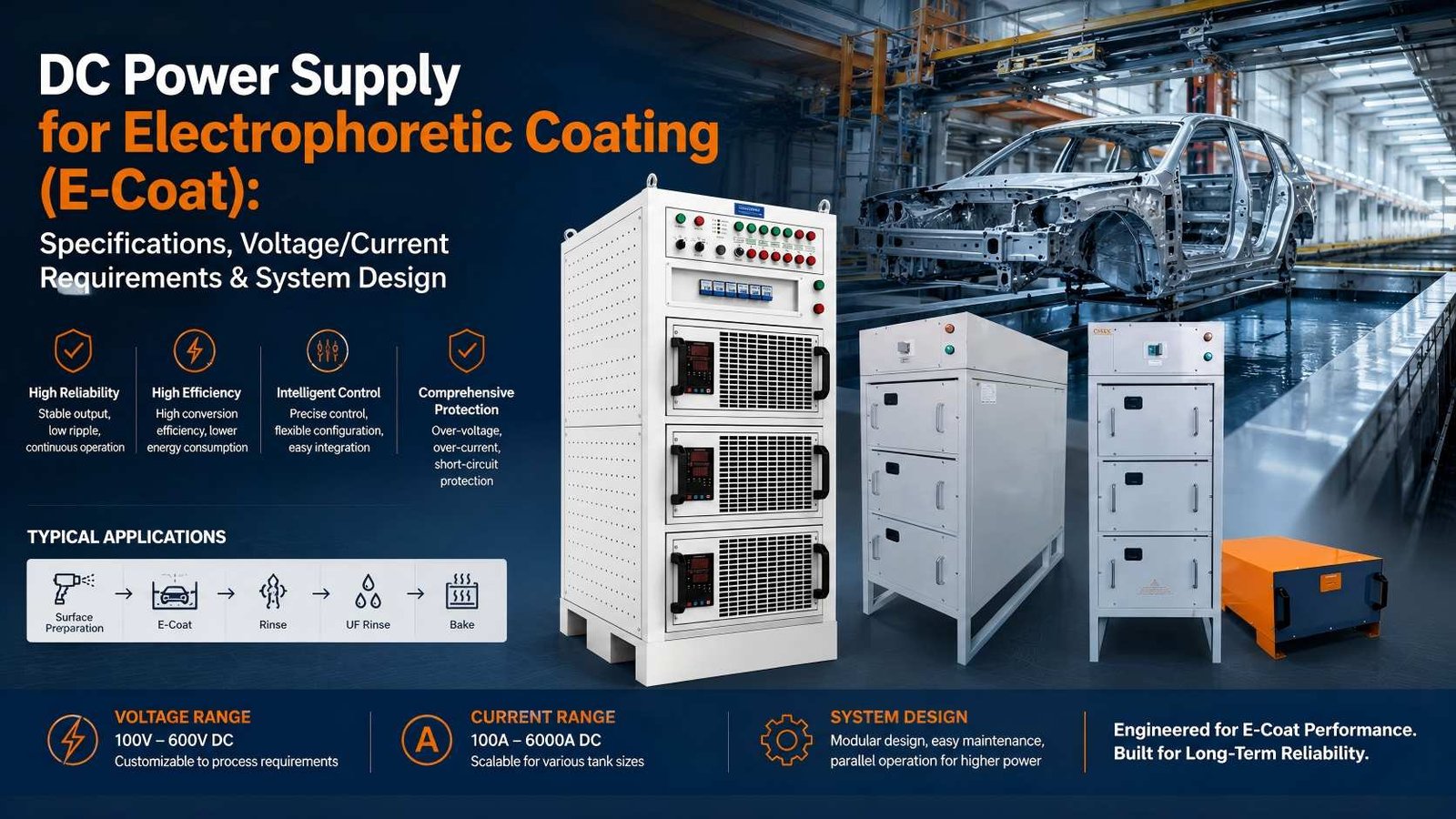
DC Power Supply for Electrophoretic Coating (E-Coat): Specifications, Voltage/Current Requirements & System Design
Electrophoretic coating (e-coat) power supply is a specialized DC rectifier that provides precisely controlled voltage and current to deposit paint particles onto metal substrates through electrochemical attraction, achieving uniform film thickness (15-35 μm), 98%+ transfer efficiency, and superior corrosion protection (1000+ hours salt spray) for automotive, appliance, and industrial parts.
According to ASTM D3967-22, electrophoretic deposition processes require DC power supplies with <1% ripple RMS and ±1% voltage regulation to ensure consistent coating thickness and adhesion quality in automotive and industrial finishing applications.
E-Coat Process Overview & Power Supply Requirements
Electrophoretic coating (also called e-coat or electrocoating) uses electrical current to deposit charged paint particles from a water-based bath onto a metal substrate. The process has 4 key stages that determine power supply requirements:
- Deposition: Paint particles migrate to substrate (50-400V DC, 10-1000A)
- Film Growth: Insulating film builds, current decreases (constant voltage mode)
- Curing: Baked at 150-200°C to crosslink polymer (not power supply phase)
- Recovery: Ultrafiltrate rinse to remove unbonded paint (uses DC for ED cell)
Voltage & Current Requirements by Application
| Application | Voltage Range | Current Range | Typical Tank Size | Ripple Requirement |
|---|---|---|---|---|
| Automotive Body | 200-400V | 500-3000A | 50,000-200,000L | <0.5% RMS |
| Automotive Parts | 100-300V | 100-800A | 5,000-30,000L | <1% RMS |
| Appliance (Washer/Dryer) | 150-250V | 200-600A | 10,000-40,000L | <1% RMS |
| Fasteners/Small Parts | 50-150V | 50-300A | 1,000-5,000L | <1% RMS |
| Aerospace Components | 250-400V | 300-1500A | 20,000-80,000L | <0.5% RMS |
Critical Power Supply Features for E-Coat
1. Ripple Control (Most Important)
E-coat requires extremely low ripple (<1% RMS, ideally <0.5%) because ripple causes uneven film thickness and “orange peel” surface defects. QEEHUA e-coat rectifiers use IGBT technology with LC filtering to achieve <0.3% ripple RMS—3× better than SCR rectifiers.
2. Constant Voltage (CV) Mode with Current Limit
During e-coat deposition, the film resistance increases as paint builds, naturally limiting current. The power supply must maintain constant voltage (±0.5%) while allowing current to decrease from initial surge (200-300% of steady-state) to final steady-state value.
3. Soft Start / Ramp-Up Control
To prevent “burn-through” (excessive current at start), e-coat rectifiers need programmable voltage ramp-up (1-60 seconds adjustable). This allows gradual current increase matching the tank’s electrical characteristics.
4. Reverse Pulse Capability (Optional)
Some advanced e-coat systems use reverse pulse (anodic pulse) to improve throwing power in deep recesses. This requires bipolar DC output (positive/negative polarity switching <10ms).
5. Multi-Stage Programming
Modern e-coat lines use 2-4 voltage stages in one cycle:
| Stage | Voltage | Duration | Purpose |
|---|---|---|---|
| Pre-Deposit (Optional) | 30-50V | 5-15 sec | Wet substrate, reduce initial surge |
| Main Deposit | 200-350V | 60-180 sec | Build primary coating |
| Final Deposit | 150-250V | 30-60 sec | Even out thickness |
| Post-Flash (Optional) | 0V (drain) | 10-30 sec | Remove drag-out paint |
Comparison: IGBT vs SCR vs SCR+Filter for E-Coat
| Feature | IGBT Rectifier | SCR + LC Filter | SCR (No Filter) |
|---|---|---|---|
| Ripple (RMS) | <0.5% | 1-3% | 5-15% |
| Efficiency | 92-95% | 85-90% | 80-85% |
| Film Uniformity | Excellent | Good | Poor |
| Reject Rate | <1% | 2-5% | 5-15% |
| Power Consumption | Low | Medium | High |
| Initial Cost | High | Medium | Low |
| Operating Cost/Year | $8,000-$15,000 | $12,000-$22,000 | $18,000-$35,000 |
System Design Considerations
Tank Size & Busbar Design
For large e-coat tanks (>50,000L), power is delivered through copper busbars (200×20mm or larger) with multiple connection points to ensure <5% voltage drop across the tank. QEEHUA engineers provide busbar sizing calculations based on tank dimensions and current requirements.
Cooling System
E-coat rectifiers typically operate at 60-80% load factor (continuous), requiring robust cooling:
- Air-Cooled: Up to 800A (suitable for small tanks)
- Water-Cooled: 800A-3000A+ (preferred for large automotive lines)
- Dual-Cooling: Redundant fans + water for critical lines
Control System Integration
Modern e-coat lines integrate rectifiers with:
- PLC/SCADA: Start/stop, voltage setpoint, alarm monitoring via Modbus TCP
- Hoist System: Interlocked with rectifier (power off during load/unload)
- Paint Bath Monitoring: pH, conductivity, solid % sensors linked to rectifier for automatic voltage adjustment
QEEHUA Rectifier — Your Trusted Industrial Power Supply Partner
✓ ISO 9001:2015 Certified Manufacturing
✓ CE & RoHS Compliant Products
✓ 2,000+ Industrial Installations Worldwide
✓ Serving Clients in 80+ Countries Across 6 Continents
✓ 18-Month Standard Warranty with Lifetime Technical Support
✓ Remote Diagnostics & On-Site Service Available
Real-World Solution: Automotive Parts E-Coat Line in Turkey
A Turkish automotive supplier was experiencing 12% reject rate in their e-coat line due to uneven film thickness and orange peel defects, using an old SCR rectifier with 8% ripple. After upgrading to QEEHUA’s 400V/800A IGBT e-coat rectifier (<0.3% ripple), they achieved:
- Reject rate reduced to 0.8% (15× improvement)
- Paint consumption reduced 18% due to better transfer efficiency
- Energy cost reduced $14,000/year from 92% efficiency vs. 82% (old SCR)
Planning a New E-Coat Line or Upgrading Existing Power Supply?
Our engineers will calculate your voltage/current requirements, recommend the optimal rectifier type, and provide a complete system design including busbar layout and control integration.
Frequently Asked Questions
What voltage is needed for electrophoretic coating?
Typical e-coat voltage ranges from 50V for small parts to 400V for automotive bodies. The exact voltage depends on bath conductivity, tank size, and paint chemistry. Most systems operate between 150-350V DC. Higher voltage improves throwing power but increases risk of burn-through.
How to control current density in e-coat process?
Current density is controlled by adjusting voltage (since bath conductivity is fixed). Typical current density is 1-4 A/dm². Start with lower voltage (50-100V) and increase until desired current density is reached. Monitor part surface—if bubbling occurs, reduce voltage.
What are e-coat power supply requirements?
Key requirements: <1% ripple RMS, ±1% voltage regulation, constant voltage mode with current limit, soft-start ramp (1-60s), multi-stage programming (2-4 stages), and NEMA 4X/IP65 enclosure for chemical environment. IGBT technology is preferred over SCR for lower ripple and higher efficiency.
Can DC rectifier be used for electrophoretic coating?
Yes, DC rectifiers are the standard power source for e-coat. However, not all rectifiers are suitable—must have low ripple (<1% RMS), good voltage regulation (±1%), and chemical-resistant enclosure. General-purpose rectifiers without ripple control will cause coating defects.
How to select power supply for automotive electrocoating?
For automotive e-coat, calculate: Voltage = 200-400V (based on tank size), Current = (Tank surface area × target current density) / 1000. Add 25% margin. Select IGBT rectifier with <0.5% ripple, water-cooled if >800A. Ensure PLC integration capability (Modbus TCP standard).
What is the difference between anodic and cathodic e-coat power supply?
Anodic e-coat uses positive DC output (part is anode), cathodic uses negative DC (part is cathode). Cathodic e-coat (more common) requires negative polarity DC power supply. Some advanced systems need bipolar (switchable polarity) capability for specialized coatings.
How much does an e-coat rectifier cost?
E-coat rectifier costs: $15,000-$45,000 for 200-800A systems, $45,000-$120,000 for 800-3000A automotive body lines. IGBT rectifiers cost 20-30% more than SCR but save $10,000-$25,000/year in energy. Payback period is typically 12-18 months.
Related Products
Explore our Electrophoretic Coating Power Supply designed specifically for e-coat applications, or learn about our Surface Treatment Rectifiers for comprehensive coating line solutions.
For more technical details, read our previous articles: Cathodic Protection Rectifiers Guide and Electrocoagulation Water Treatment.