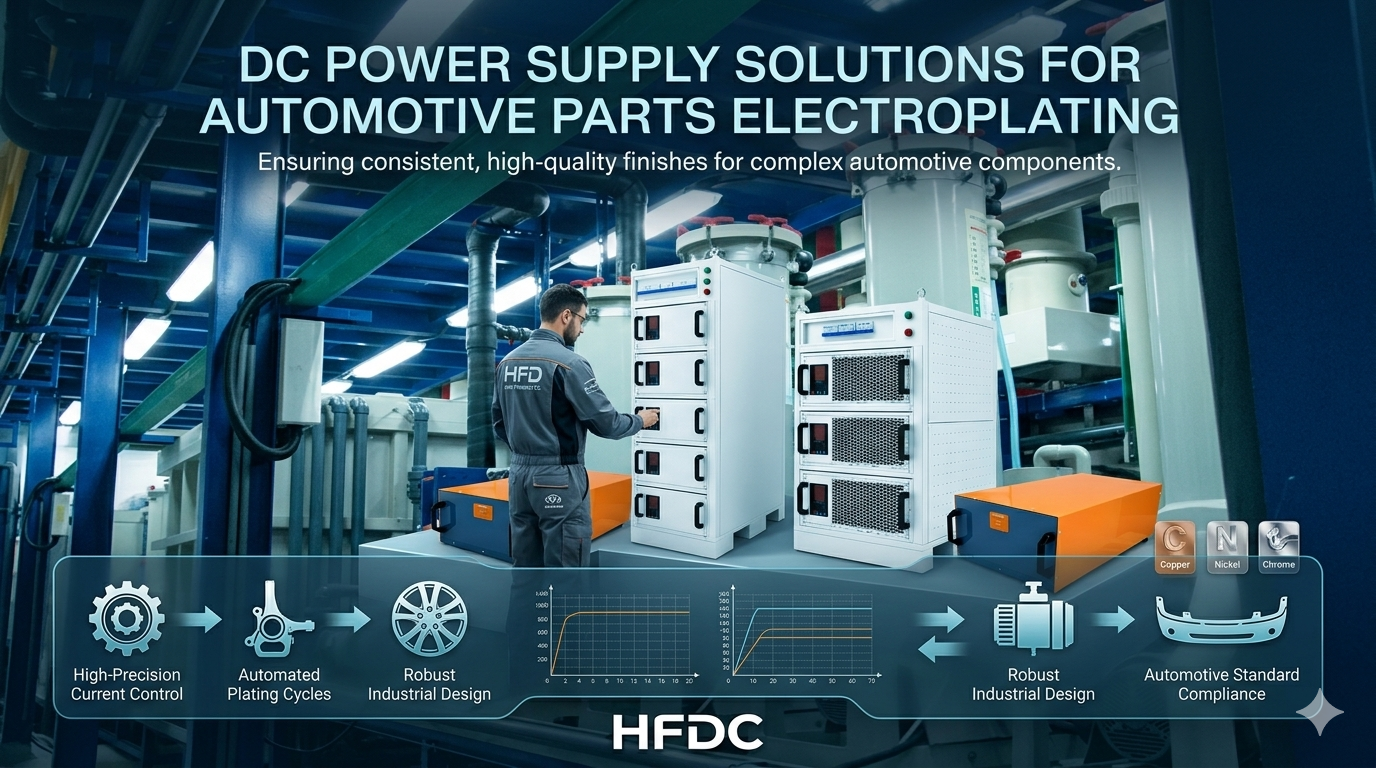
The global automotive industry is undergoing its most profound transformation in a century — and at the heart of it are the millions of electroplated components that make new energy vehicles (NEVs) lighter, safer, more durable, and more aesthetically refined. From zinc-nickel alloy-coated brake calipers to copper-struck connector housings, from decorative chrome exterior trims to phosphate-treated powertrain gears, automotive parts electroplating demands power supply performance that leaves zero margin for error.
This article examines the specific DC power supply requirements for automotive electroplating, with market context for manufacturers in India (Pune, Chennai, Gurugram), Mexico (Monterrey, Bajío, Querétaro), and Poland (Wrocław, Katowice, Poznań) — three of the world’s fastest-growing automotive manufacturing hubs.
The Stakes: Why Automotive Electroplating Has Zero Tolerance for Power Instability
Automotive OEMs and tier-1 suppliers enforce surface coating specifications measured in microns. A deviation of even ±1 μm in zinc-nickel alloy thickness on a brake caliper can trigger a complete batch rejection — representing hundreds of thousands of dollars in scrapped parts, OEM line stoppage penalties, and potential recall liability.
The root cause of thickness variation in electroplating is almost always current density fluctuation at the workpiece surface. Current density depends directly on the rectifier’s output current stability, ripple level, and response to load transients. This is why automotive plating suppliers globally are standardizing on high-frequency IGBT rectifiers with pulse-width modulation control rather than legacy SCR units.
Critical Specifications for Automotive Plating Rectifiers
Zinc-Nickel Alloy Plating (Most Demanding Application)
Zinc-nickel alloy (12–15% Ni content) is the preferred corrosion protection coating for automotive underbody parts. It requires:
| Parameter | Required Specification |
|---|---|
| Current Regulation Accuracy | ±0.5% or better |
| Output Ripple (% p-p) | <1% at rated current |
| Dynamic Response | <5 ms to ±10% load step |
| Alloy Composition Control | Current density ±2 mA/cm² |
| Ramp Rate Control | 0–100% in programmable profile |
| Reverse Pulse Capability | For alloy composition fine-tuning |
Decorative Chrome Plating (Trivalent or Hexavalent)
Modern automotive decorative chrome (both Cr³⁺ and legacy Cr⁶⁺ processes) requires:
- Extremely stable DC output (ripple <0.5%)
- Precise temperature-compensated current control
- Automatic current density adjustment as tank chemistry depletes during the shift
Copper Striking and Nickel Undercoating
Multi-layer plating sequences (Cu strike → Ni semi-bright → Ni bright → Cr) require a rectifier capable of rapid recipe switching — ideally <3 seconds between programs — to support robotic line automation where parts transit between tanks on a fixed conveyor cycle.
Market Analysis: Automotive Plating Power Demand by Region
India — The World’s Third-Largest Automotive Market
India’s automotive component manufacturing cluster — anchored in Pune (Maharashtra), Chennai (Tamil Nadu), and Gurugram/Faridabad (Haryana) — supplies parts to Tata, Mahindra, Hyundai, Suzuki Maruti, and an expanding list of Chinese EV brands establishing manufacturing presence.
Key power supply challenges for Indian automotive platers:
- Grid voltage fluctuation (±10–15% common in industrial estates) demands wide-range input rectifiers (340–460V AC input tolerance)
- High ambient temperature (35–45°C in summer) requires rectifiers with enhanced thermal management and derated performance specifications
- Cost sensitivity drives demand for 3–5 year TCO calculations rather than lowest initial price
QEEHUA’s QH-HF Series, with 380–460V ±20% input tolerance and IP54 cooling systems, is designed for Indian industrial operating conditions.
Mexico — North American Supply Chain Hub
Mexico’s automotive corridor — Monterrey (Nuevo León), León and Querétaro (Bajío region), Ciudad Juárez — supplies US, Canadian, and increasingly Asian OEMs with stamped, cast, and surface-treated components. The USMCA free trade zone drives rapid capacity expansion.
Mexican automotive platers face:
- NOM-001-SEDE electrical safety compliance requirements for imported equipment
- Preference for 460V 60Hz power systems (US standard) rather than 380V 50Hz
- Strong demand for English + Spanish bilingual documentation and support
QEEHUA supplies 460V 60Hz rectifier variants certified for North American grid standards, with Spanish-language operation manuals and Miami-based regional support.
Poland — Central European Automotive Powerhouse
Poland has emerged as Europe’s fourth-largest automotive producer, with Stellantis (Tychy), Volkswagen (Poznań), and Toyota (Wałbrzych) anchoring major supply chain clusters. Polish tier-1 suppliers face intense pressure to meet Euro NCAP safety standards and EU RoHS/ELV Directive requirements, which directly affect electroplating chemistry and process control.
Polish automotive platers require:
- CE-marked equipment (mandatory for EU market)
- REACH-compliant chemistry support (hexavalent chrome phase-out driving trivalent conversions)
- Industry 4.0 connectivity — Modbus TCP, OPC-UA, PROFINET interfaces for smart factory integration
FAQ: Automotive Parts Electroplating DC Power Supply
Q: What current capacity rectifier do I need for automotive zinc-nickel plating of brake calipers?
A: For a typical barrel plating operation processing 500–1000 kg/shift of brake calipers, you would typically need a 1000–3000A rectifier at 12–18V DC. The exact specification depends on your tank geometry, cathode efficiency, and target current density. QEEHUA’s application engineers can calculate the required power based on your tank dimensions and production targets — contact us for a free specification worksheet.
Q: How do I ensure my rectifier meets automotive OEM audit requirements (e.g., IATF 16949)?
A: IATF 16949 (automotive quality management) requires that critical process equipment — including plating rectifiers — has documented calibration records, preventive maintenance schedules, and measurement system analysis (MSA) for current and voltage outputs. QEEHUA supplies rectifiers with calibration certificates traceable to national standards, calibration reminder systems, and data logging capability for audit documentation.
Q: Can I connect my plating rectifier to our factory MES (Manufacturing Execution System)?
A: Yes — QEEHUA’s QH-Smart Series rectifiers support Modbus RTU/TCP, OPC-UA, and optional PROFINET communication, enabling real-time process data integration into MES/SCADA systems. This supports traceability requirements increasingly demanded by automotive OEMs, including real-time current density records per batch.
Q: Are there local service technicians for QEEHUA rectifiers in Mexico or Poland?
A: QEEHUA maintains authorized service partners in Mexico City, Monterrey, Guadalajara (Mexico), and Warsaw, Wrocław, Katowice (Poland). Standard spare parts (IGBT modules, driver boards, filter capacitors) are stocked at regional warehouses with 24–48 hour delivery capability.
The New Energy Vehicle Factor: Emerging Plating Opportunities
EV Battery Enclosure Plating
Lithium-ion battery pack enclosures require precise zinc or zinc-nickel plating for both corrosion resistance and electrical grounding continuity. Battery pack manufacturers in India’s emerging EV hub (Pune, Bengaluru, Hyderabad) are investing in dedicated high-accuracy rectifiers for this application.
Copper Busbar Plating for EV Power Electronics
EV inverters and onboard chargers use copper busbars with tin or silver plating to reduce contact resistance. These applications require ultra-stable DC output (ripple <0.2%) and high deposition rate capability, favoring high-frequency rectifiers over SCR alternatives.
Motor Rare Earth Magnet Plating
NdFeB permanent magnets in EV motors receive nickel or aluminum coating for corrosion protection. The magnetic material’s sensitivity to process parameters makes stable, low-noise DC power essential.
Conclusion: Partner with a Specialist for Automotive Plating Power Infrastructure
Automotive electroplating is one of the most demanding applications for DC power supply technology — and getting it right means partnering with a manufacturer who understands not just electrical engineering, but surface finishing chemistry, OEM quality systems, and the specific regulatory environment of your market.
QEEHUA Rectifier brings 15+ years of automotive plating power supply expertise to customers in India, Mexico, Poland, and 5 other global markets. Our dedicated automotive solutions team can support everything from initial specification through installation, commissioning, and ongoing process optimization.
Contact us at info@qeehuarectifier.com or visit www.qeehuarectifier.com to request an automotive plating rectifier consultation.