The Strategic Importance of Copper Foil Quality in Battery Manufacturing
The global transition to electric vehicles and grid-scale energy storage has created unprecedented demand for high-quality electrode materials, with copper foil for lithium-ion battery cathodes representing a critical bottleneck in the supply chain. China dominates global lithium battery production capacity, with manufacturing centers concentrated in Jiangsu, Zhejiang, Fujian, and Guangdong provinces that collectively account for over 70% of worldwide output.
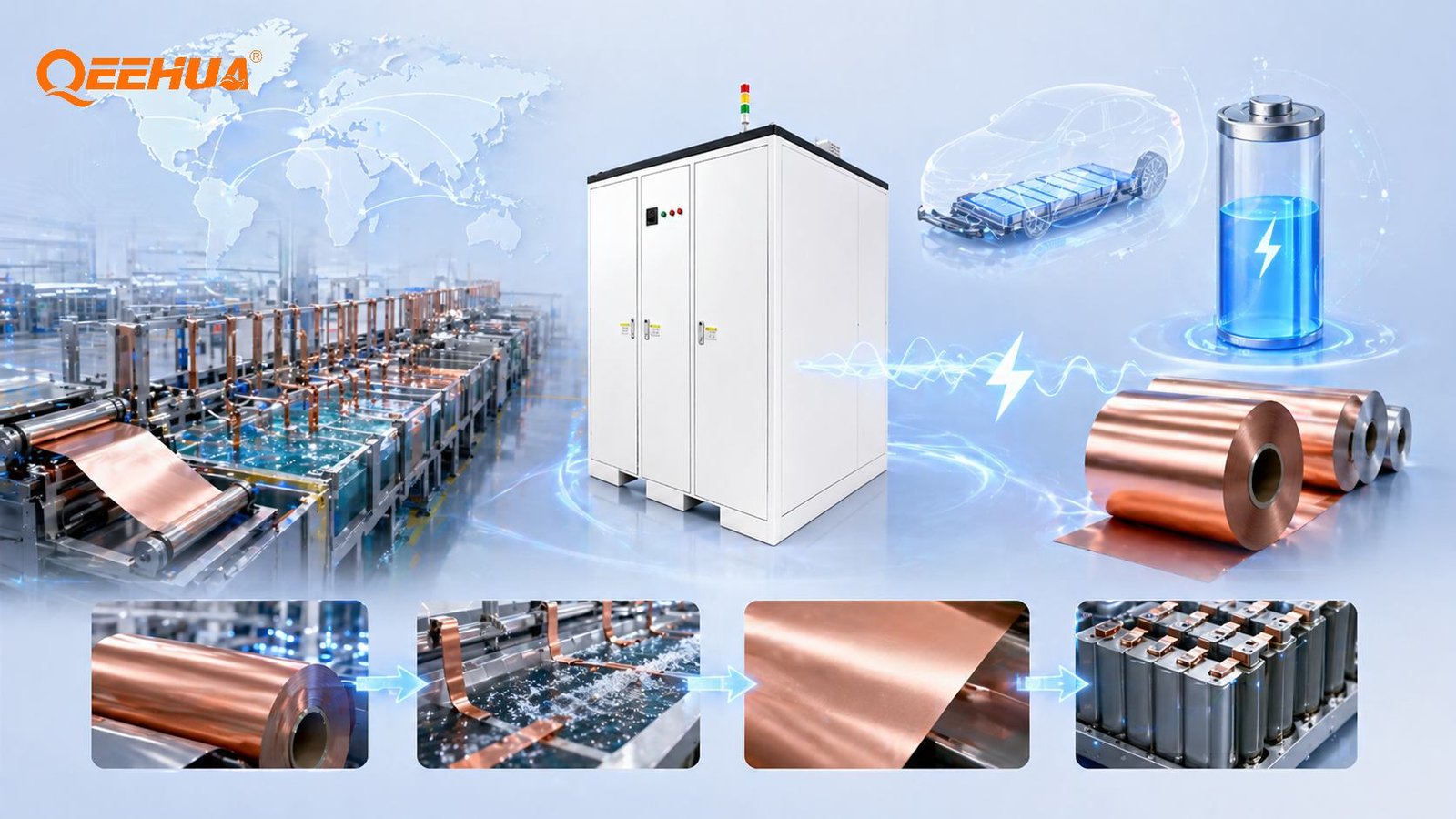
Copper foil electroplating represents a specialized application where rectifier specifications directly determine product quality characteristics that impact battery performance, safety, and longevity. The technical requirements for battery-grade copper foil—featuring thicknesses below 10 microns, surface roughness below 0.3 micrometers Ra, and tensile strength above 400 MPa—demand exceptional DC power control capabilities from the electroplating rectifier systems.
This comprehensive guide examines the power engineering requirements for battery-grade copper foil production, translating technical specifications into practical equipment selection criteria for manufacturers in China’s rapidly expanding lithium battery supply chain.
Understanding Battery-Grade Copper Foil Specifications
Physical Property Requirements
Battery manufacturers specify copper foil properties that directly correlate with electrochemical cell performance. Thickness uniformity within ±10% across foil width and ±5% along foil length ensures consistent electrode coating weights that enable predictable cell capacity and cycling performance. Surface morphology requirements—including specific roughness parameters and grain structure characteristics—influence electrode adhesion, electrolyte wetting, and long-term structural stability during charge-discharge cycling.
The standard specification for battery-grade copper foil includes:
- Thickness range: 6-15 μm for cathode applications
- Surface roughness: Ra < 0.3 μm (matte side), Ra < 0.5 μm (shiny side)
- Tensile strength: > 400 MPa (annealed state)
- Elongation: > 8% (annealed state)
- Oxygen content: < 30 ppm
- impurities: < 50 ppm total metallic impurities
Achieving these specifications requires precise control of electroplating parameters including current density, electrolyte composition, temperature, and agitation. The rectifier serves as the primary control element for current density regulation, making power supply selection a critical decision point for foil manufacturers.
Electroplating Process Characteristics
The drum-type electroplating system commonly employed for battery-grade copper foil operates with the substrate (titanium drum or moving substrate) rotating through the plating electrolyte at controlled speeds. Current density application typically ranges from 300-800 A/m², significantly higher than conventional electroplating applications, to achieve acceptable production throughput while maintaining surface quality.
The relationship between current density and foil properties follows predictable patterns that inform rectifier specification requirements. Higher current densities increase production rate but risk degradation of surface morphology and mechanical properties if not properly controlled. The optimal operating window varies with electrolyte formulation, temperature, and agitation intensity, requiring rectifiers that can maintain stable output despite process parameter variations.
DC Power System Requirements for Copper Foil Electroplating
Voltage and Current Specifications
Battery-grade copper foil electroplating rectifiers must deliver DC output at voltages typically ranging from 6-24V, with current requirements scaling to production line width and speed. A standard commercial production line processing 1000mm wide foil at 20 meters per minute might require rectifier capacity of 3000-5000A, while wide-format lines (1500mm width) operating at higher speeds can require 8000-15000A per rectifier unit.
QEEHUA’s high-current rectifiers, rated for operation up to 500KA in standard configurations, provide the power capacity necessary for large-scale copper foil production. The modular architecture of QEEHUA’s systems enables parallel configuration of multiple power modules to achieve required current ratings while maintaining redundancy for continuous operation.
Efficiency and Power Quality Requirements
Energy efficiency directly impacts production economics for copper foil manufacturers operating high-volume production lines. Rectifier efficiency losses translate directly into operating cost increases, with power consumption representing a significant portion of total production cost for electricity-intensive electroplating processes.
QEEHUA’s rectifiers achieve typical efficiencies of 88-92% at full load operation, with efficiency curves optimized for the continuous-duty operating profile typical of foil production lines running 24 hours per day. The phase-angle control methodology inherently provides power factor correction benefits, with measured power factors exceeding 0.92 at normal operating conditions without additional PF correction equipment.
Ripple current specification represents a critical parameter for copper foil electroplating. Excessive ripple produces periodic variations in deposition rate that create surface bands with different grain structures and property characteristics. QEEHUA specifies ripple currents below 5% of rated output for standard configurations and below 2% for premium configurations optimized for high-surface-quality requirements.
FAQ: Copper Foil Electroplating Power
Q: What current density is optimal for battery-grade copper foil electroplating?
A: Standard battery-grade copper foil production operates at current densities between 300-800 A/m². Lower current densities (300-500 A/m²) produce smoother surfaces with better mechanical properties but lower productivity. Higher densities (600-800 A/m²) increase throughput but require tighter process control to maintain surface quality specifications. The optimal current density depends on specific customer requirements and equipment capabilities.
Q: How does rectifier ripple affect copper foil surface quality?
A: Current ripple creates periodic variations in plating rate that manifest as surface bands with different grain structures. Ripple above 5% typically produces visible surface markings that fail appearance specifications. For high-quality battery foil, QEEHUA recommends specifying ripple below 2% to ensure consistent grain structure and surface morphology across the entire foil width.
Q: What redundancy configuration is recommended for continuous copper foil production?
A: QEEHUA recommends N+1 redundant configuration for critical production lines where downtime costs exceed rectifier equipment costs. For standard production lines, 2N configuration (complete standby system) provides the highest availability. The modular design of QEEHUA rectifiers enables graceful degradation where individual module failures reduce capacity without complete production stoppage.
Q: How does electrolyte temperature influence rectifier requirements?
A: Electrolyte temperature affects both conductivity and deposition kinetics, requiring rectifier systems to accommodate load variations as bath temperature changes during extended operation. QEEHUA’s temperature compensation features automatically adjust output parameters based on bath temperature feedback, maintaining consistent current density despite thermal variations. For facilities in Guangdong province, where summer ambient temperatures elevate baseline bath temperatures, enhanced cooling capacity becomes an important specification consideration.
Q: What communication protocols do copper foil manufacturers use for rectifier integration?
A: Modern copper foil production lines typically integrate rectifiers with distributed control systems via Modbus TCP, EtherNet/IP, or Profinet protocols. QEEHUA supports all standard industrial protocols and can provide custom protocol implementation for proprietary control systems. Data logging requirements for quality traceability systems are supported through OPC-UA connections to MES platforms.
Equipment Selection Criteria for Chinese Foil Manufacturers
Production Scale Considerations
Equipment selection must align with production scale and market positioning. High-end battery manufacturers (CATL, BYD, CALB) specify foil suppliers with demonstrated capability for consistent quality at high throughput. Medium-scale manufacturers may prioritize flexibility and cost-effectiveness over maximum throughput.
QEEHUA’s rectifier portfolio spans the full range of requirements, from compact 1000A systems suitable for pilot production to modular configurations exceeding 20000A for high-volume production lines. Regional application engineers in Jiangsu (near major foil manufacturing clusters) and Guangdong provide on-site consultation for equipment specification.
Process Development and Optimization Support
Beyond equipment supply, QEEHUA supports process development activities that help foil manufacturers optimize their electroplating parameters for specific product targets. This includes:
- Current density optimization studies to balance productivity against quality requirements
- Electrolyte formulation recommendations in collaboration with chemical suppliers
- Surface treatment process development for specialized foil specifications
- Quality testing protocols to validate process capability
These support services prove particularly valuable for manufacturers entering the battery-grade foil market from adjacent industries (such as standard electrolytic copper foil for circuit boards) where the quality requirements differ significantly.
Future Technology Trends and Power System Implications
High-Speed Foil Production Requirements
Emerging production technologies push foil line speeds beyond current commercial capabilities, with pilot lines demonstrating production rates exceeding 100 meters per minute. These higher speeds directly translate to increased current density requirements, with rectifier specifications potentially exceeding current commercial product ratings.
QEEHUA’s R&D partnerships with leading foil equipment manufacturers position the company to address next-generation production requirements through advanced rectifier architectures. These developments include enhanced cooling systems, higher-efficiency power conversion topologies, and integrated process monitoring capabilities that will support foil specifications for solid-state batteries and other emerging cell chemistries.
Alternative Anode Materials
While copper foil dominates current lithium-ion battery anodes, emerging technologies including silicon-based anodes and lithium metal anodes may reduce copper foil demand in certain applications. These market dynamics create uncertainty that influences equipment investment decisions. QEEHUA’s flexible manufacturing capabilities and modular product architecture enable production capacity adjustments aligned with market evolution, providing risk mitigation for capital-intensive equipment investments.