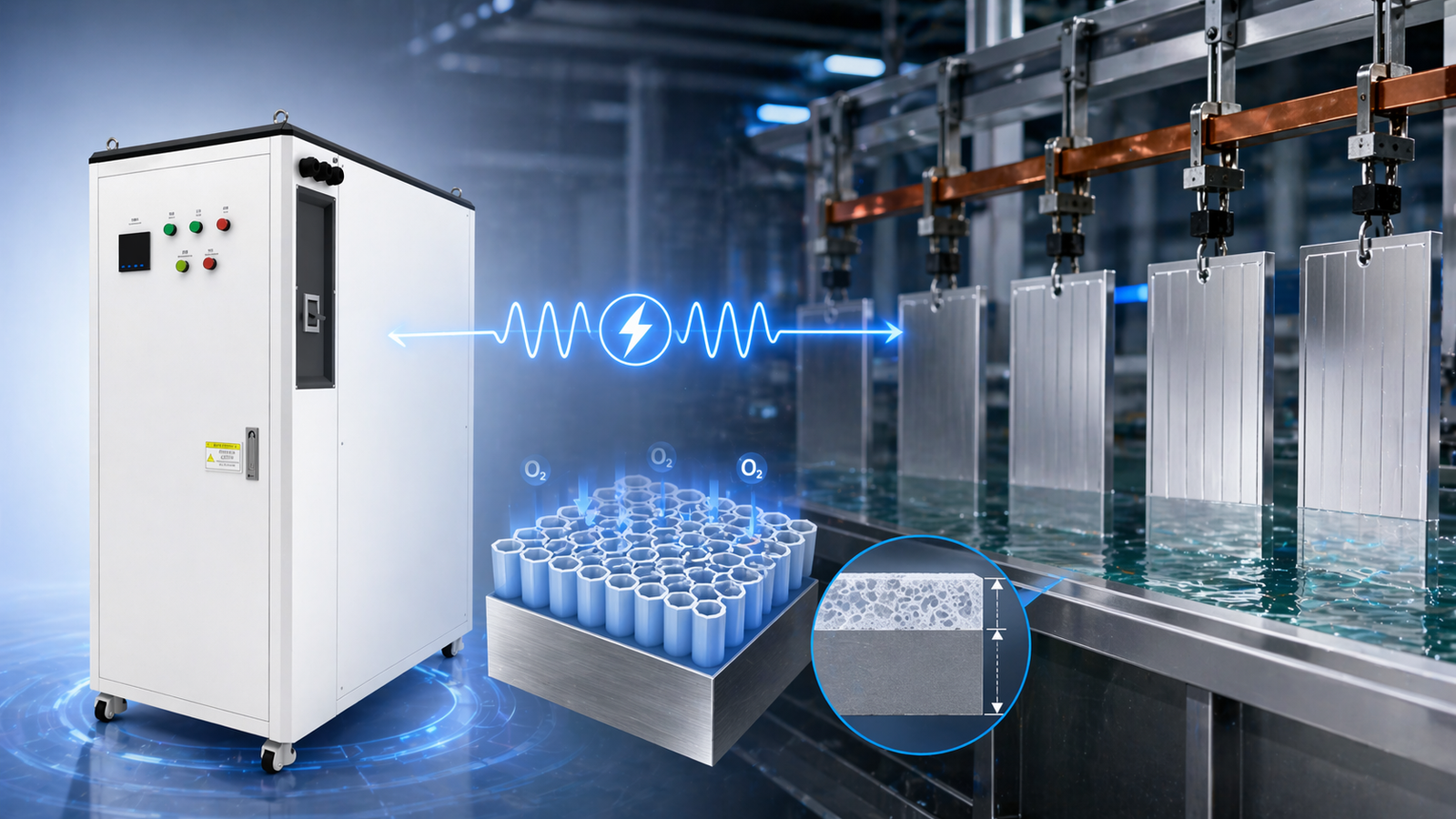
An anodizing power supply is a regulated DC power source that delivers precisely controlled voltage and current to drive the electrochemical oxidation of aluminum surfaces, forming a dense, protective aluminum oxide layer.
Anodizing Power Supply: Complete Selection Guide for Aluminum Surface Treatment
An anodizing power supply is a regulated DC power source that delivers precisely controlled voltage and current to drive the electrochemical oxidation of aluminum surfaces, forming a dense, protective aluminum oxide layer. The power supply is the most critical variable in the anodizing process — directly determining oxide thickness, hardness, porosity, and color consistency.
The global anodizing market is valued at approximately $12.5 billion in 2026, driven by demand from aerospace, automotive, architecture, consumer electronics, and defense industries. Aluminum anodizing is irreplaceable: it simultaneously improves corrosion resistance, wear resistance, electrical insulation, and cosmetic appearance without adding significant weight.
This guide covers everything you need to select the right anodizing power supply for your specific process.
Anodizing Process Overview: What the Power Supply Is Doing
In anodizing, the aluminum workpiece is connected as the anode in an electrolytic cell containing sulfuric acid (most common), oxalic acid, chromic acid, or specialized mixtures. DC current drives oxidation at the aluminum surface:
At the anode (aluminum):
2Al → 2Al³⁺ + 6e⁻
→ Aluminum oxide forms: 2Al³⁺ + 3O²⁻ → Al₂O₃
The power supply’s role: Maintain precise, stable voltage and current throughout this process. Fluctuations cause thickness variation, burning, smearing, and color inconsistency.
Types of Anodizing: Different Power Needs
| Anodizing Type | Electrolyte | Voltage Range | Current Density | Oxide Thickness | Key Application |
|---|---|---|---|---|---|
| Type I: Chromic Acid | 5–10% CrO₃ | 0–40V | 0.5–2 A/dm² | 0.5–2.5 µm | Aerospace, MIL-spec |
| Type II: Sulfuric Acid (standard) | 15–20% H₂SO₄ | 12–22V | 1–2 A/dm² | 5–25 µm | Architectural, consumer |
| Type III: Hard Anodizing | 10–15% H₂SO₄ (cold) | 25–100V | 2–5 A/dm² | 25–150 µm | Automotive, defense, industrial |
| Type IV: Phosphoric Acid | Phosphoric acid | 10–20V | 1–2 A/dm² | 0.5–2 µm | Adhesive bonding prep |
| Decorative/Color Anodizing | Sulfuric acid | 12–22V | 1–2 A/dm² | 5–20 µm | Consumer electronics, jewelry |
| Micro-arc Oxidation (MAO) | Alkaline solution | 300–700V | 5–20 A/dm² | 5–200 µm | Aerospace, biomedical |
Critical insight: Standard anodizing (Type II) needs only 12–22V. Hard anodizing (Type III) requires up to 100V. Micro-arc oxidation demands 300–700V. You must specify the correct voltage range before purchasing.
Key Electrical Specifications to Evaluate
1. Output Voltage Range
- Standard anodizing: 0–30V adjustable
- Hard anodizing: 0–100V adjustable
- Micro-arc oxidation: 0–750V adjustable
- Best practice: Always specify 20–30% voltage headroom above your maximum process requirement
2. Output Current (Amperage)
Calculate required current:
Required Current (A) = Current Density (A/dm²) × Total Surface Area (dm²)
Example:
Hard anodizing of automotive parts: 3 A/dm² × 500 dm² surface = 1,500A minimum
Specify a 2,000A or 3,000A rectifier for 25–30% safety margin.
QEEHUA’s anodizing power supplies cover 0–100KA output — from small job shops (100A) to large architectural aluminum extrusion lines (50,000A+).
3. Output Ripple
This is often overlooked but critically important.
| Anodizing Type | Recommended Ripple | Effect of High Ripple |
|---|---|---|
| Type II standard | <3% acceptable, <1% preferred | Color variation, thickness variation |
| Type III hard anodizing | <1% required | Burning, poor hardness |
| Decorative/color | <1% required | Color inconsistency, blotching |
| Type I chromic acid | <2% | Adhesion variation |
Recommendation: Specify a rectifier with <1% ripple for all anodizing applications. IGBT high-frequency rectifiers naturally achieve this; SCR units typically produce 3–8% ripple which is marginal for quality anodizing.
4. Current/Voltage Ramp Control
Aluminum anodizing requires careful current ramp-up, especially for hard anodizing:
- Standard anodizing: Linear current increase over 3–10 minutes to avoid burning
- Hard anodizing: Programmed voltage ramp (often starting at 15V and stepping to 100V) to control heat generation
- Requirement: Look for programmable ramp rate (A/min or V/min) in the control system
5. Long-Term Stability
Anodizing runs typically last 20–60 minutes per batch. The power supply must maintain output stability within ±0.5% for the entire cycle duration to ensure uniform oxide thickness.
IGBT vs SCR for Anodizing: Definitive Answer
| Performance Factor | SCR Rectifier | IGBT Rectifier |
|---|---|---|
| Ripple | 3–8% | <1% |
| Voltage regulation | ±2–5% | ±0.1–0.5% |
| Response to load change | Slow (100–500 ms) | Fast (<10 ms) |
| Hard anodizing suitability | ❌ Marginal | ✅ Excellent |
| Decorative anodizing color | ❌ Inconsistent | ✅ Consistent |
| Energy efficiency | 75–85% | 90–95% |
| Programmable ramp | Difficult | Standard feature |
| Remote monitoring | Retrofit only | Built-in |
Conclusion: For any anodizing application requiring consistent quality — which is most commercial anodizing — IGBT high-frequency rectifiers deliver significantly better results. For hard anodizing or decorative color work, IGBT is essentially mandatory.
Hard Anodizing: Special Requirements
Hard anodizing (Type III) is the most demanding anodizing application and the most sensitive to power supply quality:
Process conditions:
- Electrolyte: 10–15% H₂SO₄ at 0–5°C (refrigerated)
- Voltage: 25–100V (programmed profile)
- Current density: 2–5 A/dm²
- Time: 30–120 minutes
Power supply requirements for hard anodizing:
- Voltage up to 100V (standard 24V/36V units are inadequate)
- Ripple <1% — Hard oxide layers are extremely sensitive to ripple
- Programmable voltage stepping — Typically ramp from 25V → 50V → 75V → 100V over 15–20 minutes
- Current limiting with precision — Prevents burning during the initiation phase
- Temperature monitoring interface — Electrolyte temperature must stay below 5°C
- Continuous duty rating — Runs for up to 2 hours per batch
QEEHUA’s hard anodizing power supply series (0–100V, 100A–100,000A) is specifically designed for these requirements with programmable voltage profiles, precision current limiting, and full data logging.
Anodizing Power Supply Sizing Examples
Example 1: Small Job Shop (Jewelry/Electronics)
- Parts: Small aluminum components, 50 dm² average
- Process: Type II sulfuric acid, 2 A/dm²
- Required current: 50 dm² × 2 A/dm² = 100A
- Recommended: 150A, 0–30V IGBT rectifier
Example 2: Medium Architectural Extrusion Plant
- Parts: Aluminum window/door profiles, 2,000 dm² per batch
- Process: Type II, 1.5 A/dm²
- Required current: 2,000 × 1.5 = 3,000A
- Safety margin: 20% → 3,600A
- Recommended: 5,000A, 0–30V IGBT water-cooled rectifier
Example 3: Automotive Hard Anodizing Line
- Parts: Engine components, 500 dm² per batch
- Process: Type III hard anodizing, 3 A/dm²
- Required current: 500 × 3 = 1,500A
- Voltage: Up to 100V required
- Recommended: 2,000A, 0–100V IGBT hard anodizing rectifier with programmable voltage profile
Example 4: Large-Scale Aerospace Anodizing
- Parts: Aircraft structural components, 10,000 dm² per batch
- Process: Type I chromic acid or Type II
- Required current: 10,000 × 1.5 = 15,000A
- Recommended: 20,000A, 0–60V water-cooled IGBT rectifier
Features Checklist for Anodizing Power Supply Purchase
Before requesting a quote, confirm these specifications:
- Maximum output voltage (30V / 60V / 100V / 750V for MAO)
- Maximum output current (calculated from area × current density)
- Output ripple specification (<1% for quality work)
- Cooling type (air-cooled ≤3,000A / water-cooled >3,000A)
- Voltage/current ramp programming (essential for hard anodizing)
- Stability specification (±0.5% or better for batch consistency)
- Control interface (standalone panel / Modbus / PROFINET for automation)
- CE certification (required for European market)
- Data logging (for ISO/IATF quality documentation)
- Warranty and local service support
Frequently Asked Questions
What voltage do I need for anodizing?
Standard sulfuric acid anodizing (Type II) requires 12–22V. Hard anodizing (Type III) requires up to 100V. Micro-arc oxidation requires 300–750V. Always specify your process type before ordering — using a standard 24V rectifier for hard anodizing is a common and expensive mistake.
What is the best power supply for anodizing aluminum?
For most commercial anodizing, an IGBT high-frequency rectifier with <1% output ripple, programmable current/voltage ramp, and CE certification is the best choice. SCR rectifiers are adequate for low-quality general work but are not recommended for decorative, hard, or precision anodizing.
How do I calculate the power supply size for anodizing?
Multiply the total aluminum surface area (in dm²) by the required current density (typically 1–3 A/dm²). Add 20–30% safety margin. For example: 1,000 dm² at 2 A/dm² = 2,000A required → specify a 2,500A or 3,000A unit.
Why does ripple matter for anodizing?
Ripple causes periodic fluctuations in the anodizing current, producing non-uniform oxide growth. High ripple results in thickness variation, color inconsistency in decorative work, and reduced hardness in hard anodizing. For quality anodizing, specify ripple <1%.
Can one power supply handle both standard and hard anodizing?
Yes, if the voltage range covers both processes (0–100V is sufficient for both Type II and Type III). Ensure the unit has programmable voltage profiles, as hard anodizing requires a stepped voltage ramp rather than a fixed voltage setpoint.
Does QEEHUA supply anodizing power supplies globally?
Yes. QEEHUA ships anodizing power supplies to 40+ countries with CE certification. Output ranges from 100A to 100,000A, voltage from 0–750V (MAO capable). Custom designs are available for non-standard specifications.
Summary: Choosing Your Anodizing Power Supply
The right anodizing power supply is defined by four parameters: voltage range (matching your process type), current output (matching your surface area), ripple specification (<1% for quality work), and ramp control (essential for hard anodizing).
IGBT high-frequency rectifiers outperform SCR units in all of these areas, at a total ownership cost that is typically 20–35% lower over a 10-year period when energy savings are included.
QEEHUA anodizing power supply specifications:
- Output voltage: 0–750V DC (customizable)
- Output current: 100A–100,000A (customizable)
- Ripple: <1% standard, <0.5% precision models
- Cooling: Air-cooled ≤3,000A; Water-cooled >3,000A
- Certifications: CE, ISO 9001
- Interface: Standalone / Modbus / PROFINET
- Applications: Type I, II, III, IV anodizing + Micro-arc oxidation